

The Moving Temples of Kathmandu Valley - Part II
Since time immemorial, humans have created temples. It is a place of worship where individuals offer their prayers and gratitude to their deities. These infrastructures are static, making it difficult for all to reach them at times. Whereas in Nepal, temples move from one place to another in select few days. A process in which, god comes to our squares and doorsteps.
In Nepal Mandala (Ancient Nepal), the natives took notes from various neighbouring cultures and devised a unique system. They noticed how their temples were static, and with age, its citizens were not able to make long commutes to offer prayers and gratitude to their deities. Thus, they envisioned a magnificent secondary temple. These were to be mobile, allowing those incapable of reaching the main temple to bask in the gods' aura.
These temples were to be crafted seasonally and display symbolic markers of the deity. For mobility, they envisioned a temple with wheels. They would be created in a manner to mimic the primary temple and display its hallmarks. This ambitious dream of the past developed the rich cultural reality of modern Nepal.
The biggest festival of the Newars revolves around these very mechanized temples.
It helped strengthen faith and communal unity among the diaspora. It also became a catalyst in the development of Newar culture and heritage.
Renowned for trade endeavours, Newars amassed wealth and built themselves a robust network. They invested in magnificent temples and dedicated their success to them. Today these have become the hallmark of Newar culture and tradition.
There are numerous chariot festivals dedicated to various deities of Kathmandu valley. Amongst them, some chariots are a feat of human ingenuity that feature unique craft and symbolism. In this article, we shall explore in brief these elements along with handy information which shall add value to your journey of discovering the true beauty of Nepal.
The chariot festival of Rato Matysendranath
A jewel of the citizens of Lalitpur, it is dubbed the longest in the world. Worship and revelling of Rato Matsyendranath, natively known as Karunamaya (Lord of Compassion) and Bunga Dyo (God of Bungamati), last for almost 3-4 months.
Centred around the samaritan act of Matsyendra, who helped the kingship and people of Nepal Mandala during the Lichhavi era, this chariot festival is an earnest dedication to his compassion. As per the Matysendra vamshavali (chronicle), Nepal mandala faced a crisis in a bygone era. A series of unfortunate events caused crops to wither: a famine that lasted for 12 years.
Over time various interpretations developed of the cause. The most popular is of Lord Goraknath, a discipline of Matysendranath meditating upon the great nagas (snakes) leading to a drought. But a scientific analysis using holistic overview, observation and comparative analysis shows how it was a mysterious disease that ravaged the farms of Nepal Mandala.
Society was agricultural. Farming was the backbone of our economy. The citizens practised a subsistence form of living and were highly dependent on their farming yields. Thus, such an infection proved deadly.
The monarch of Nepal Mandala, King Baradeva, consulted with his chief astrologer Bandhudatta Acharya. He advised making a journey to Kamakhya in Assam. He must have learned about the geographical similarities and their agricultural prowess through historical insight and networks. King Narendra Deva (father of King Bara Deva, who had left worldly affairs to live in a monastery in Bhadgeon), priest Bandhudatta and Rathacakra Jyapu left for Kamakhya.
They acquainted Matsyendra, a leprous agricultural master of Kamakhya who provided the needed to the trio. As per the vamshavali, they returned with a holy vessel (Kalash) containing the essence of Matsyendra. Interpreting this scientifically, he (Matsyendra) must have provided various seeds that would suit Nepal Mandala's topography. He must have also imparted the needed knowledge to make agriculture sustainable and reliable.
Matsyendra being leprous is through my research observations. Devotees are not allowed to touch his idol. You shall become leprous is communicated to them by the caretakers. The statue moulded for the chariot festival is a replica of him. The weak stature and disfigured hand is a telltale sign that helps add weight to my findings.
POPULAR ITINERARIES
SIMILAR POSTS

The Moving Temples of Kathmandu Valley - Part I
Even though an imitation, over the years, the festival of Seto Matsyendranath has created its own identity. It has developed various symbols and is a timeless heritage of Kathmandu. Today it is known as Jana Baha Dyo (God of Jana Bahal of Ket twah). The idol is viewed as Aryavalokiteswara (God of compassion) by devotees.
The moving temple of Seto Matsyendranath
When King Gunakamadeva created a new city north of Lalitpur, it was a sight to behold. He named it 'Suvarna- pranali- Kantipur' (Wright, 1990, p.154). The monarch, however, was not satisfied. He greatly missed Matsyendra of Lalitpur, his glorious temple in Bunga and the chariot festival. He wished for his new city to have something similar.
"Then, in imitation of the Lokeswara jatra of Patan, he made an image of Khasarppa Lokeswara, and caused his jatra to be celebrated every year." (Wright, 1990, p.155)
A shikhara style temple within the Hambal monastery housed Khasarppa Lokeswara. During the last years of the Lichhavi era of Nepal Mandala (Ancient Nepal), Mukunda Sena, King of Palpa, attacked this valley. "The victorious soldiers broke and disfigured the images of the gods, sent the Bhairava placed in front of Machchindranatha to their own country, Palpa and Butawal." (Wright, 1990, p.171)
The Bhairab stolen from the Hambal monastery today is known as Tansen Bhairab. The shikhara temple and monastery were in ruins. In the aftermath, people found that the statue was lost. Hundreds of years later, during the reign of Yaksha Malla, it was discovered by potters looking for clay. King Yaksha recognised the ancient idol when it was brought to the palace by them.
From here on, it became Yamaleswara.
The site of its rediscovery was renamed Yamal (today is known as Jamal) by the monarch. "The king, having seen the image, performed the rituals of renovation; took the image inside the city and established it by building a large temple." (Bajracharya et al., 2016, p. 90)
He built a mammoth temple in the cortex of Jana Baha in Ket Twah. During the reign of his son Pratapa the grounds of Hambal monastery was converted into a pond. The temple was rebuilt but housed a different deity. "Pratapa Malla, then rebuilt the chariot of Lokesvara, the white Matsyendra, according to tradition. He had Lokesvara placed on the chariot and initiated an annual procession that moved the chariot around the city." (Bajracharya et al., 2016, p. 106)
From then on, the image was called white (seto) Matsyendra.
Members of various communities tasked with creating the chariot finish the building process by Chaitya Dashain. On this day, the idol is placed on a palanquin and brought to Durbarmarg. A traditional musical ensemble leads the march. A loud cheer erupts once the parade reaches the area.
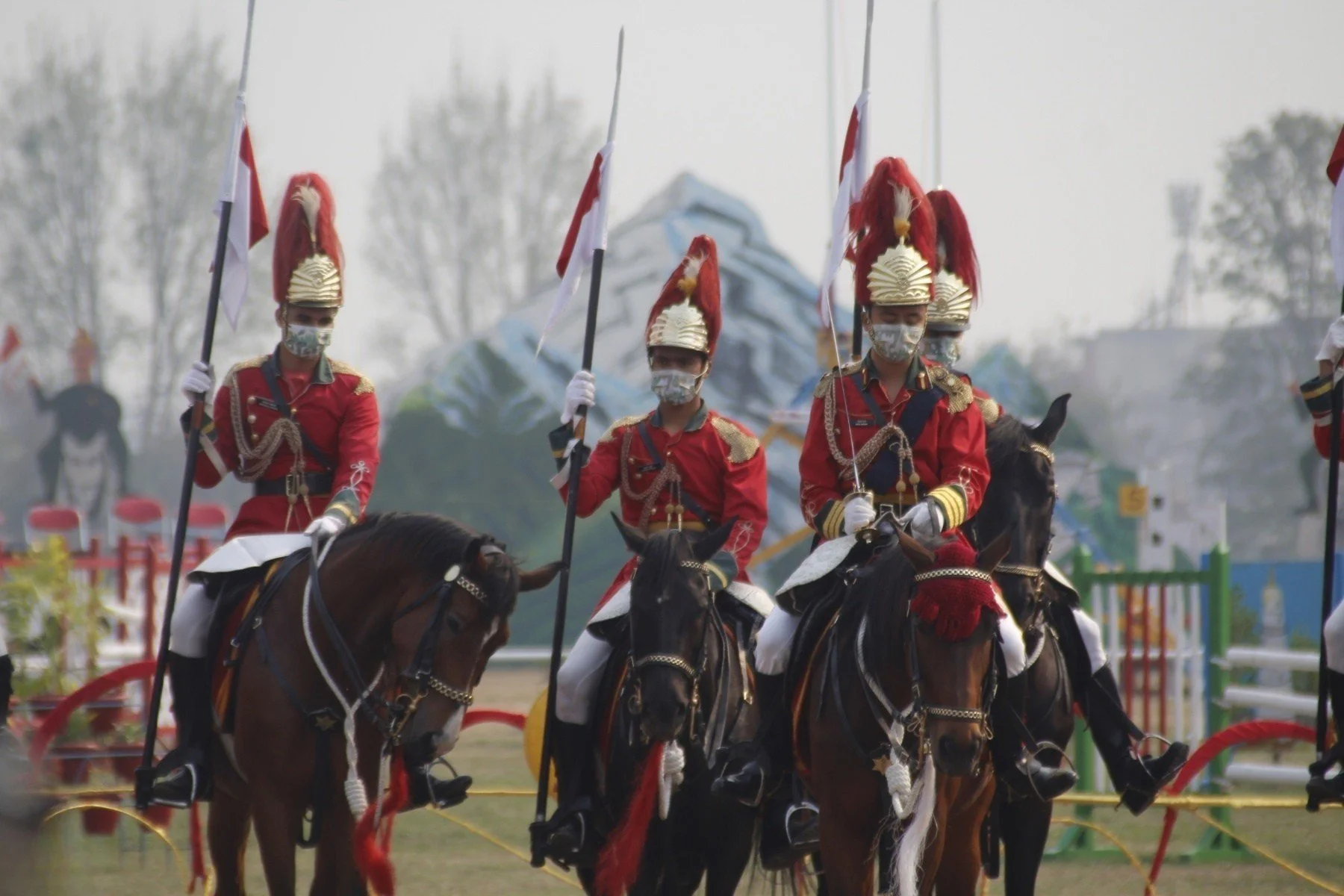
The statue is placed within the chariot by the caretakers. A military regiment dressed in traditional Gurkha uniform offers salutations. Three muskets perform an aerial salute once the wheels make their first spin.
The revellers pull it to Asan Chowk. In the next two days, the chariot circumvents the traditional route and reaches Lagan. It circles the mother tree thrice. After which, the festival comes to an end.
The festival falls on the following days in 2021 AD.
Day 1 of chariot festival - Durbarmarg- Bhota Hiti- Asan - 20th April 2021
Day 2 of chariot festival - Asan - Indra Chowk- Basantapur - 21st April 2021
Day 3 of chariot festival - Basantapur- Maru- Jasi Dewal- Lagan - 22nd April 2021
References
Wright, D. (1990). History of the kingdom of Nepal. Asian Educational Services. (Original work published 1877)
Bajracharya, M., Gutschow, N., & Michaels, A. (2016). Nepālikabhūpavaṃśāvalī (History of Kings of Nepal): Vols. 1 (Introduction and Translation) (First edition). Himal Books.
POPULAR ITINERARIES
SIMILAR POSTS
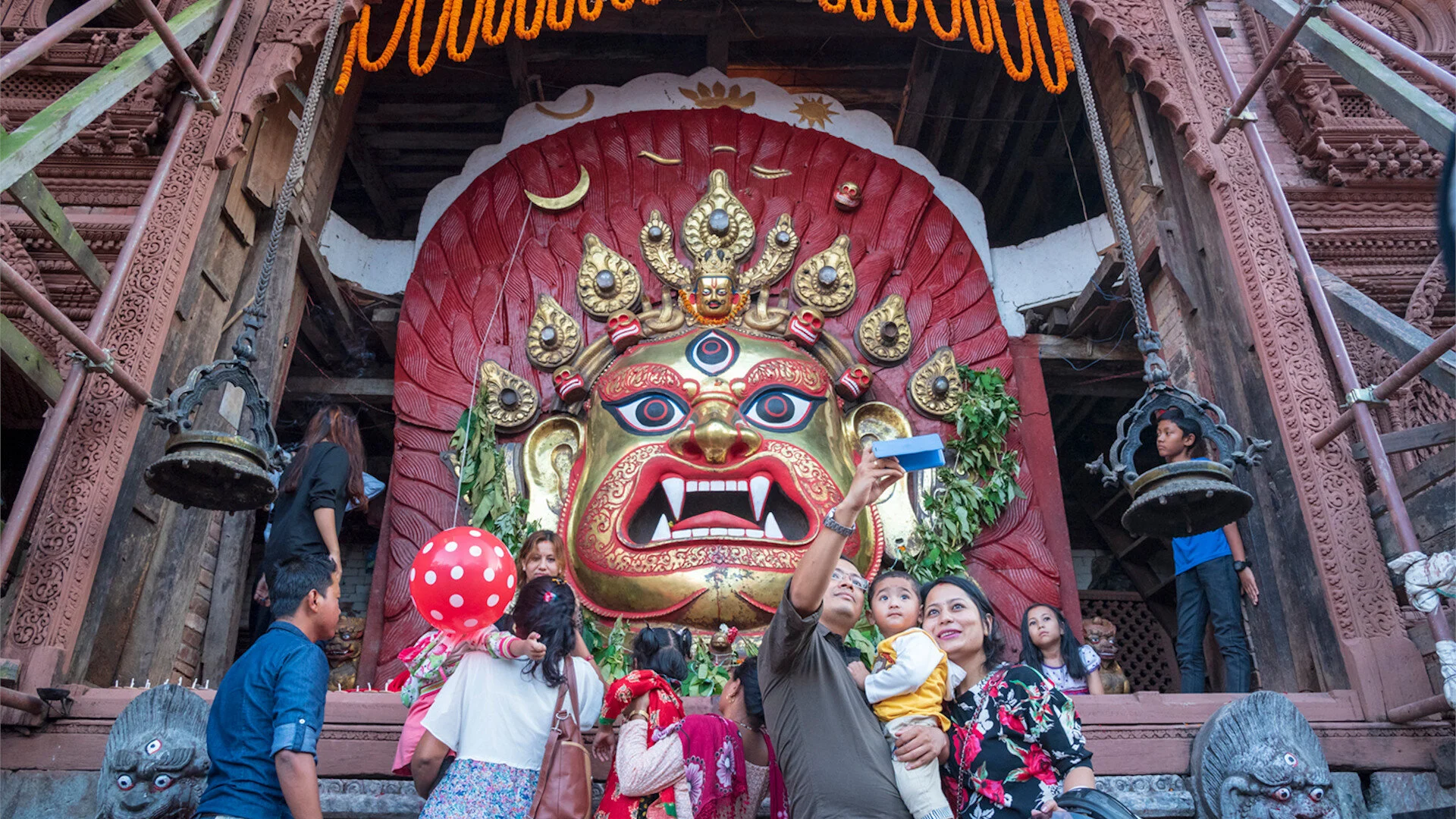

The Vermilion Festival: Sindoor Jatra
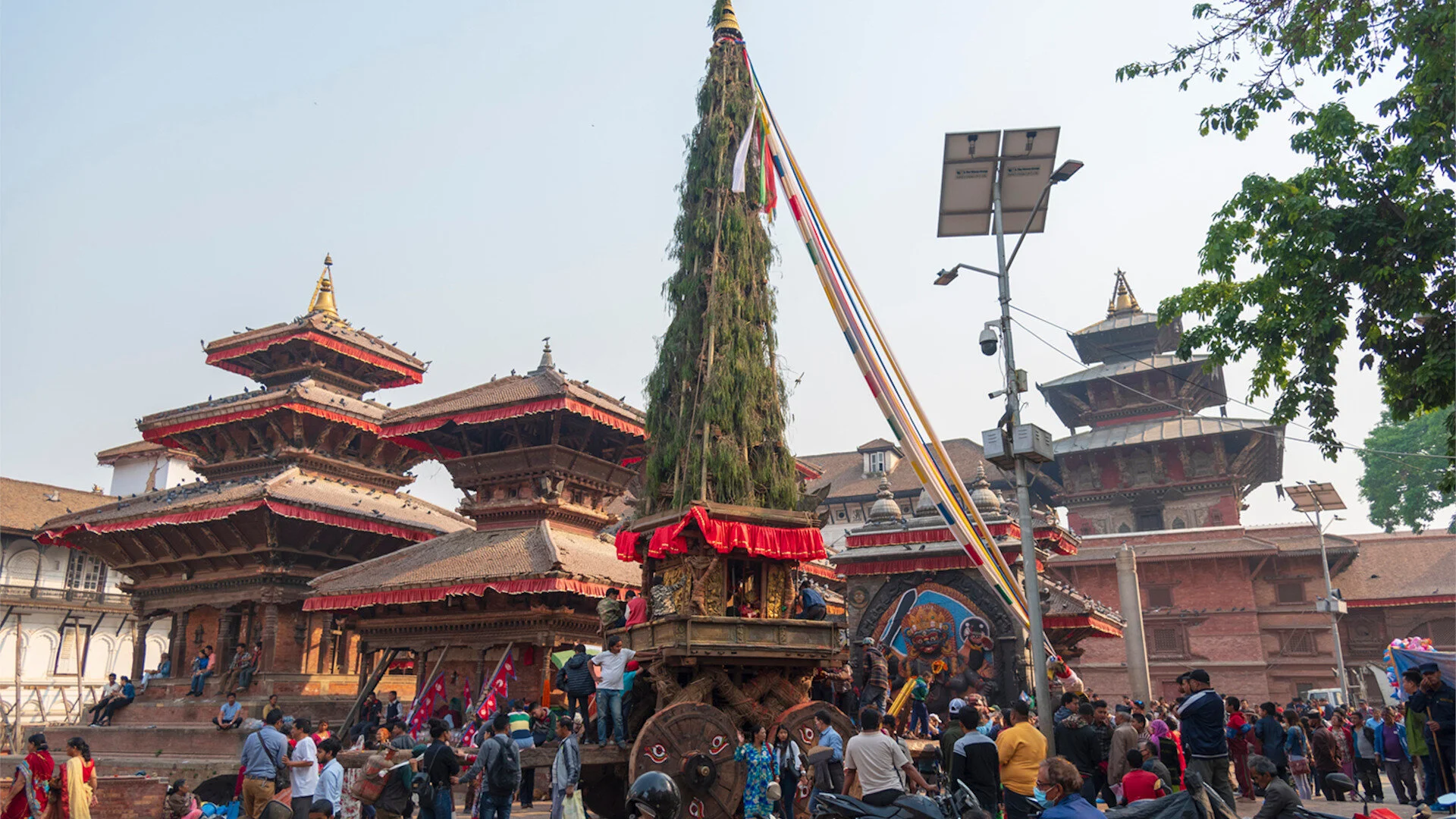
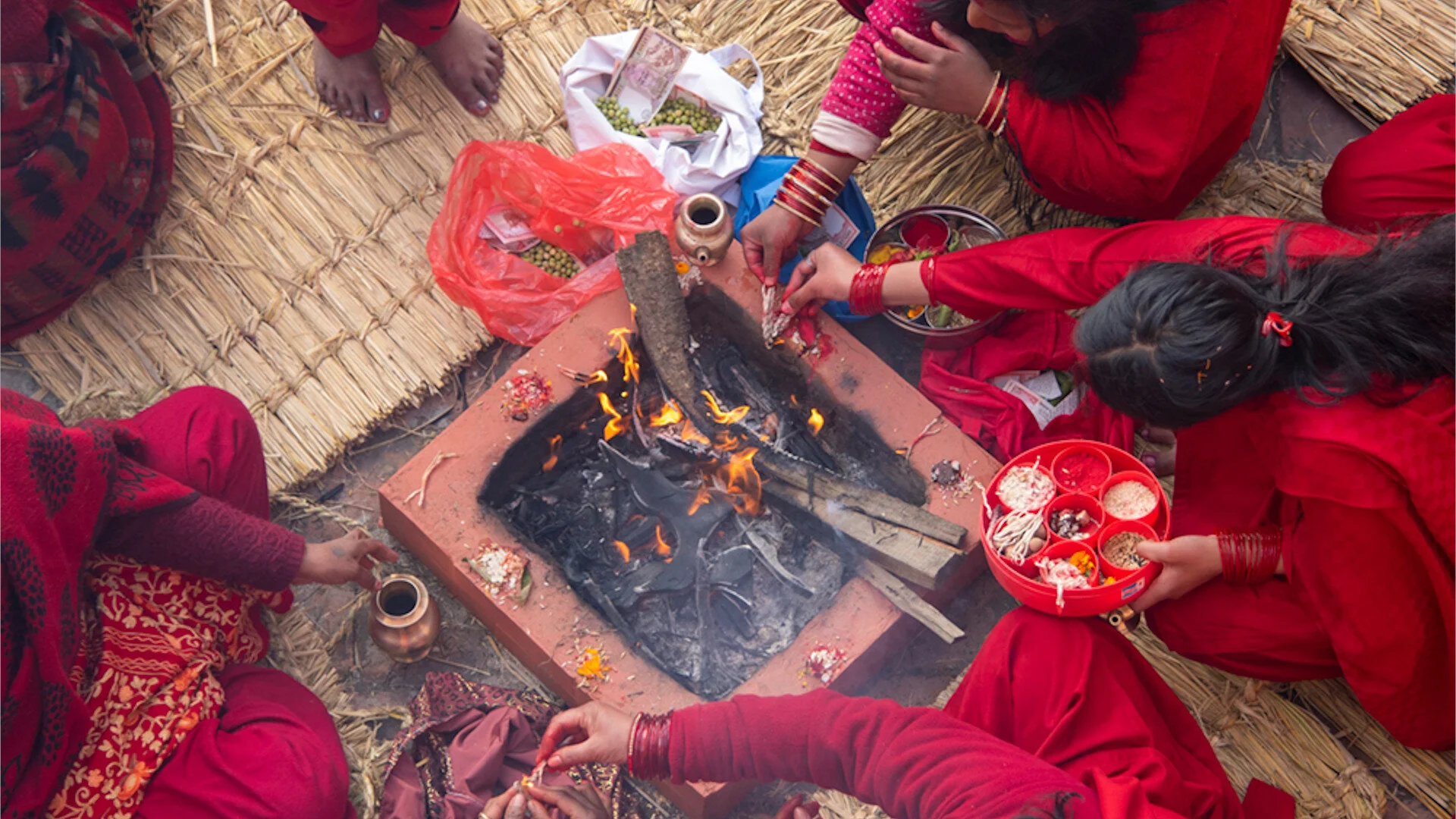
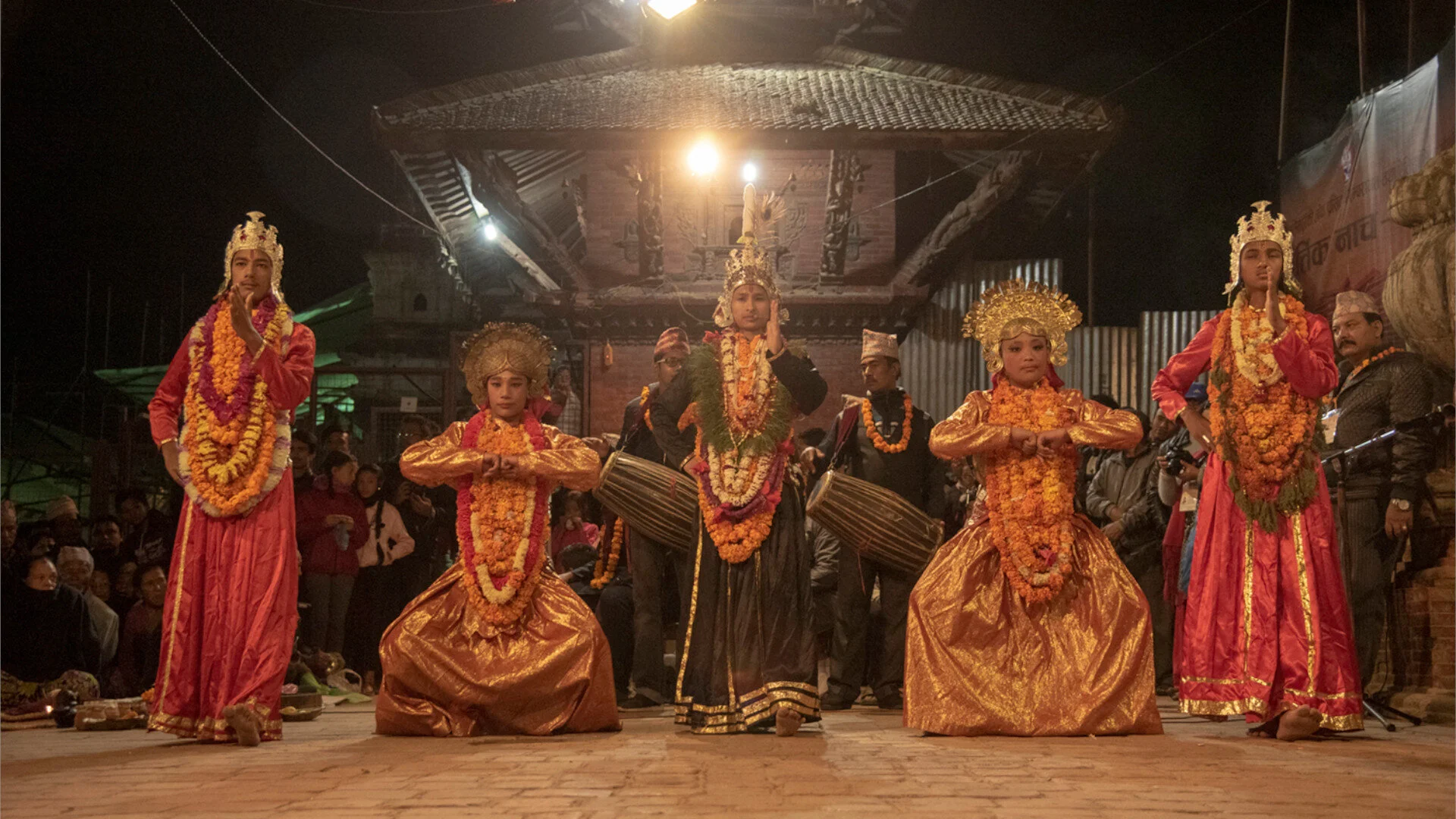
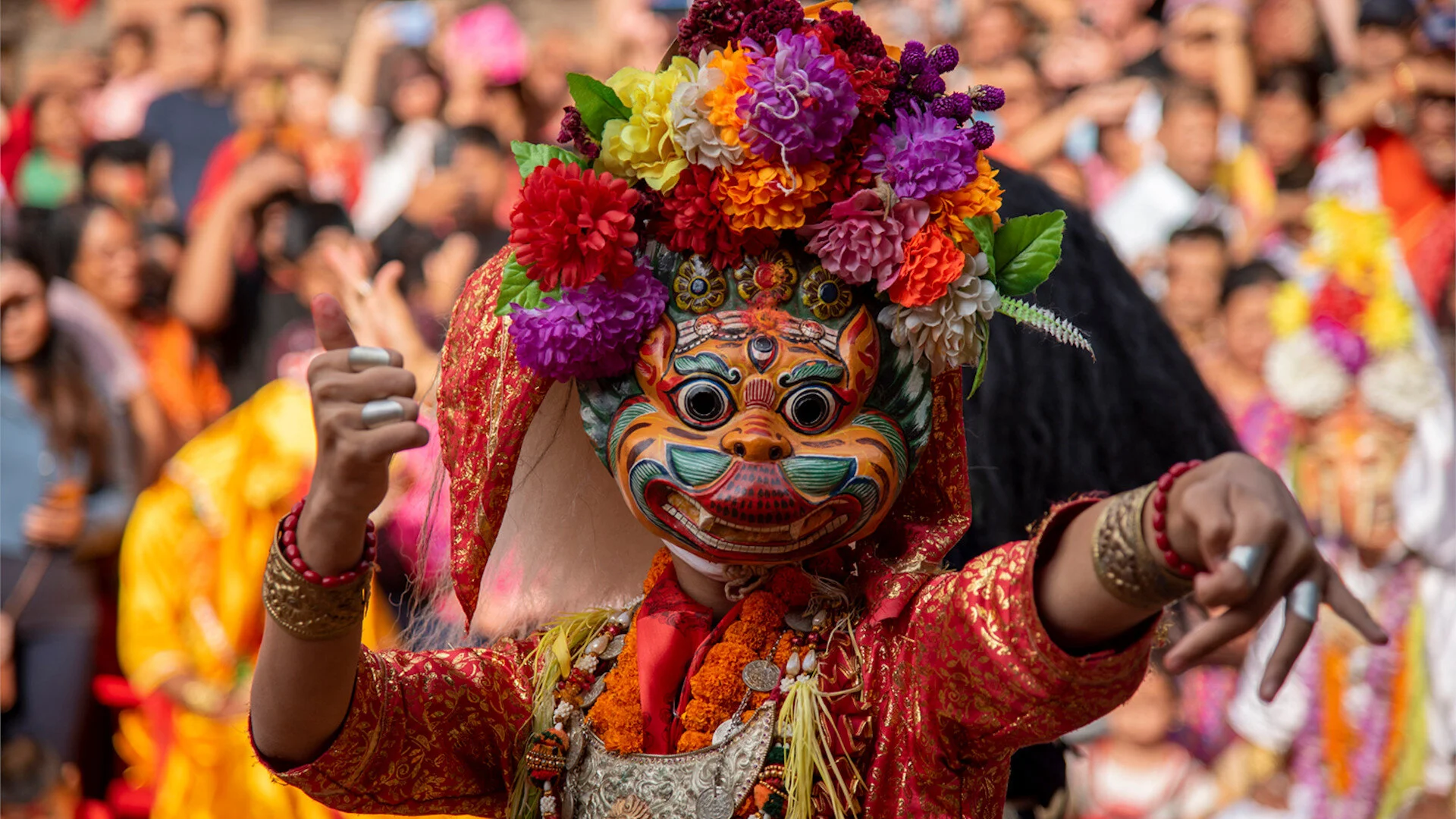
Commonly referred to as Sindoor Jatra, it is also known as Biska Jatra of Thimi. It is one of the most vibrant festivals celebrated in Kathmandu Valley. The highlight is the ceremonial use of vermilion powder which adds a new layer of pomp and flair. The locals rejoice for four days during the new year period, devotees offer prayers and worship various gods and goddesses.
Even though celebrated in a Newar township, the Sindoor Jatra is the jubilation of the Nepali new year (Vikram Sambat). Newars generally do not celebrate the solar new year, rather mark Nhu Daya bhintuna in October. The festivities occur in the locales of Thimi and Bode. The festival begins a day before the new year day. The locals perform Gunsin Chhoyekegu, which means firing of forest wood.
A traditional wooden pole known as yoshin is erected outside the temple premises of Balkumari by locals. It, however, has sadly been discontinued due to various reasons. A chariot festival takes place in Vishnuvir during the day. Deities are taken on khats (chariots) to Kwachhen (Dakshin Barahi) from Layakhu during the night. Once the revellers reach Kwachhen they revolve the chariot multiple times.
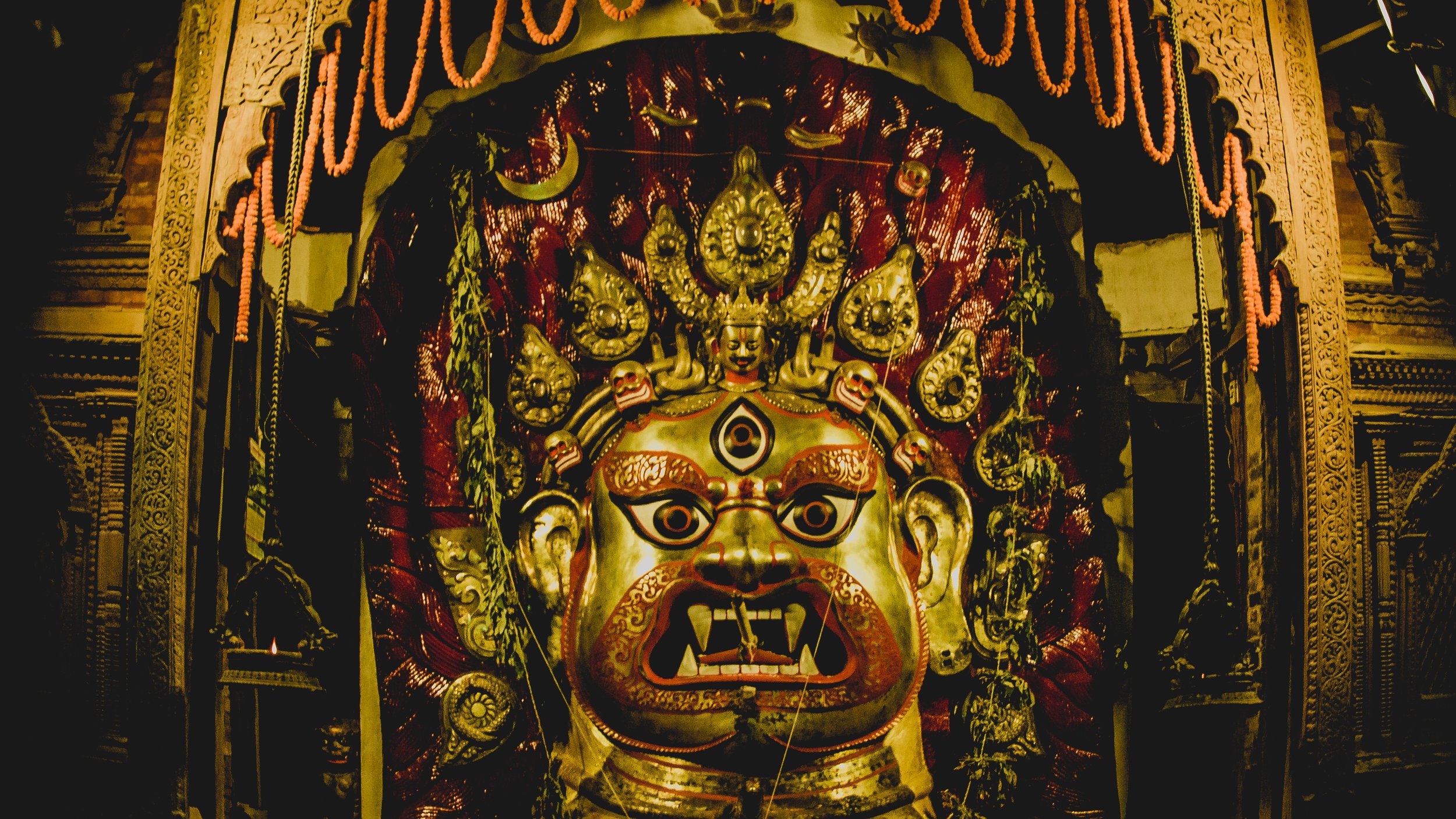
On new years day, devotees present offerings and pray to Balkumari. They flock in masses to her temple in old Thimi. Through time immemorial, she is the consort of Bhairab. They both are the guardian deities of Kathmandu Valley.
During the evening, devotees perform righteous acts such as lighting oil lamps. Some even place them on their legs, chest, forehead, arms and lie static for hours.
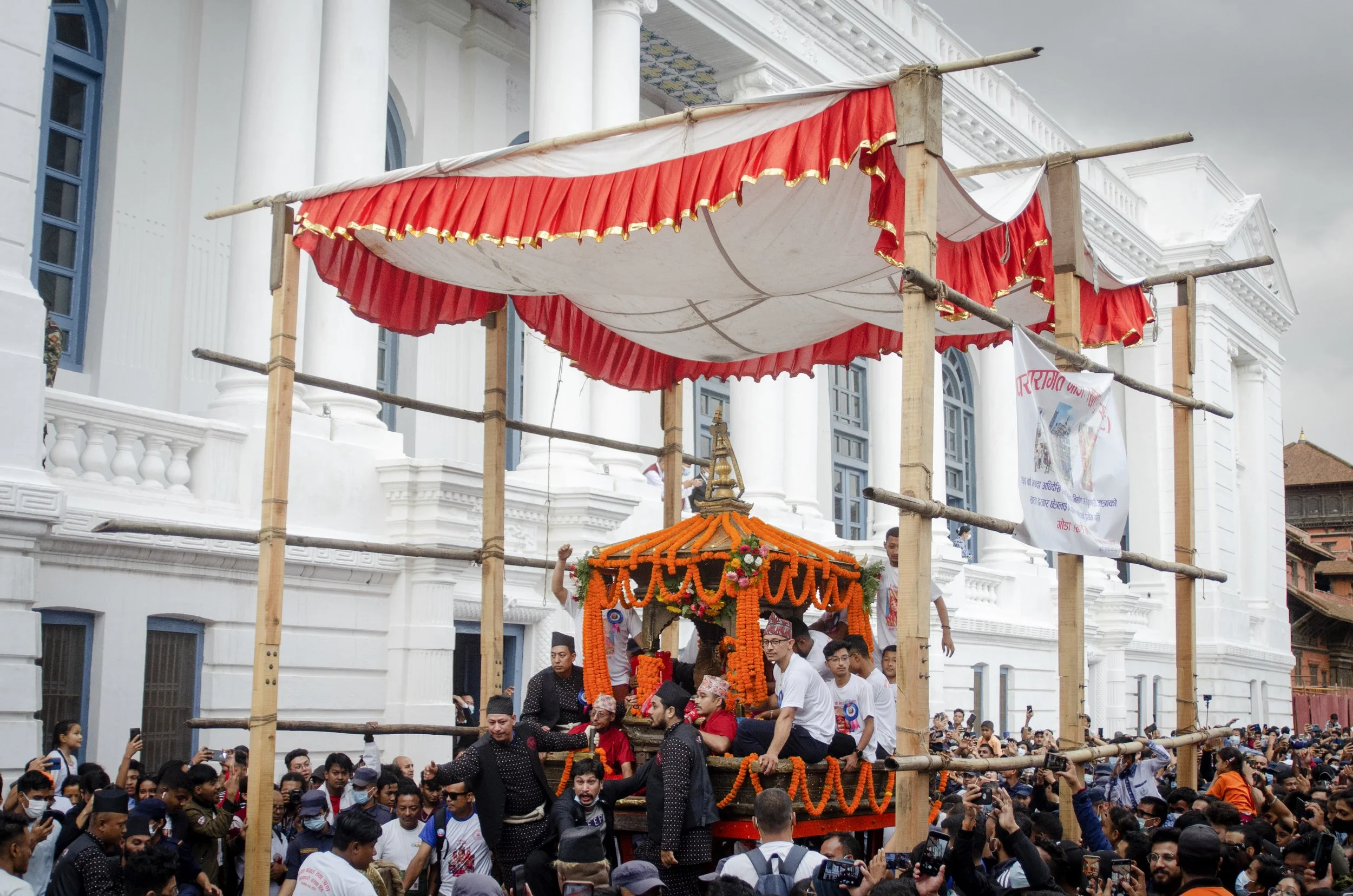
The next day (2nd Baisakh) is the highlight of this festival. Several khats (chariots) are carried to the Balkumari temple in the morning by revellers. Thirty-two khats are spaced around the temple which later circumvent it. To liven up the atmosphere, musicians play Dhimay Baja (traditional drums and cymbals). These tunes help encourage the revellers. Devotees and locals colour each other in vermilion powder, a symbol of prosperity. The entire area is filled with vibrancy and joy as devotees make merry while revolving their community chariots.
Thousands await for an idol of Ganesha, which is brought from Nagadesh by locals. Commonly referred to as Khat Ganesh, once his chariot arrives, a loud cheer erupts. Once Ganeshas’ chariot completes circumventing the temple premises, it tries to make a break for home. Revellers hoist up their chariots, and a game of catch ensues. Other chariots try to block its path. By hook or crook, Khat Ganesh is brought back to Nagadesh by revellers. The festival does not end until Khat Ganesh reaches Nagadesh.
After which, the procession of chariots makes way for the Taleju temple. A sizeable number of animal sacrifices are made here by the priests. Once the ceremonies are over, members carry the chariots back to their community, bringing an end to the festivities.
Simultaneously in the village of Bode, seven chariots are circumvented through a prescribed route. At Bhangu Tole of Bode, the iconic tongue piercing festival occurs. A member of the Shrestha clan of Bode volunteers to have his tongue (jibro) pierced. The locals believe spirits enter his body, and he experiences a spiritual trance. With an iron spike pierced in his jibro, he carries around a bamboo rack on his shoulder. Multiple flaming torches are placed on the frame by righteous men. He then walks around town in a designated route.
Locals believe that a successful tongue piercing ceremony brings good fortune to the villagers and the volunteer. The act though painful is righteous and holy. The volunteer becomes the town hero until next year.
The next day (3rd Baisakh) is the Biska Jatra of Chapacho and Bode. Communal chariots are taken around the area by locals who rejoice and make merry.
The end of this act draws Biska Jatra to a close. It is a unique festival native to the principalities of Bhaktapur. Marked with great fanfare: it is also known as the festival of human emotion. Over the years, it has become a non-tangible landmark of Bhaktapur, which draws thousands of onlookers and devotees. It, along with multiple similar festivals, help create Nepal’s image as a lifetime experience.
POPULAR ITINERARIES
SIMILAR POSTS
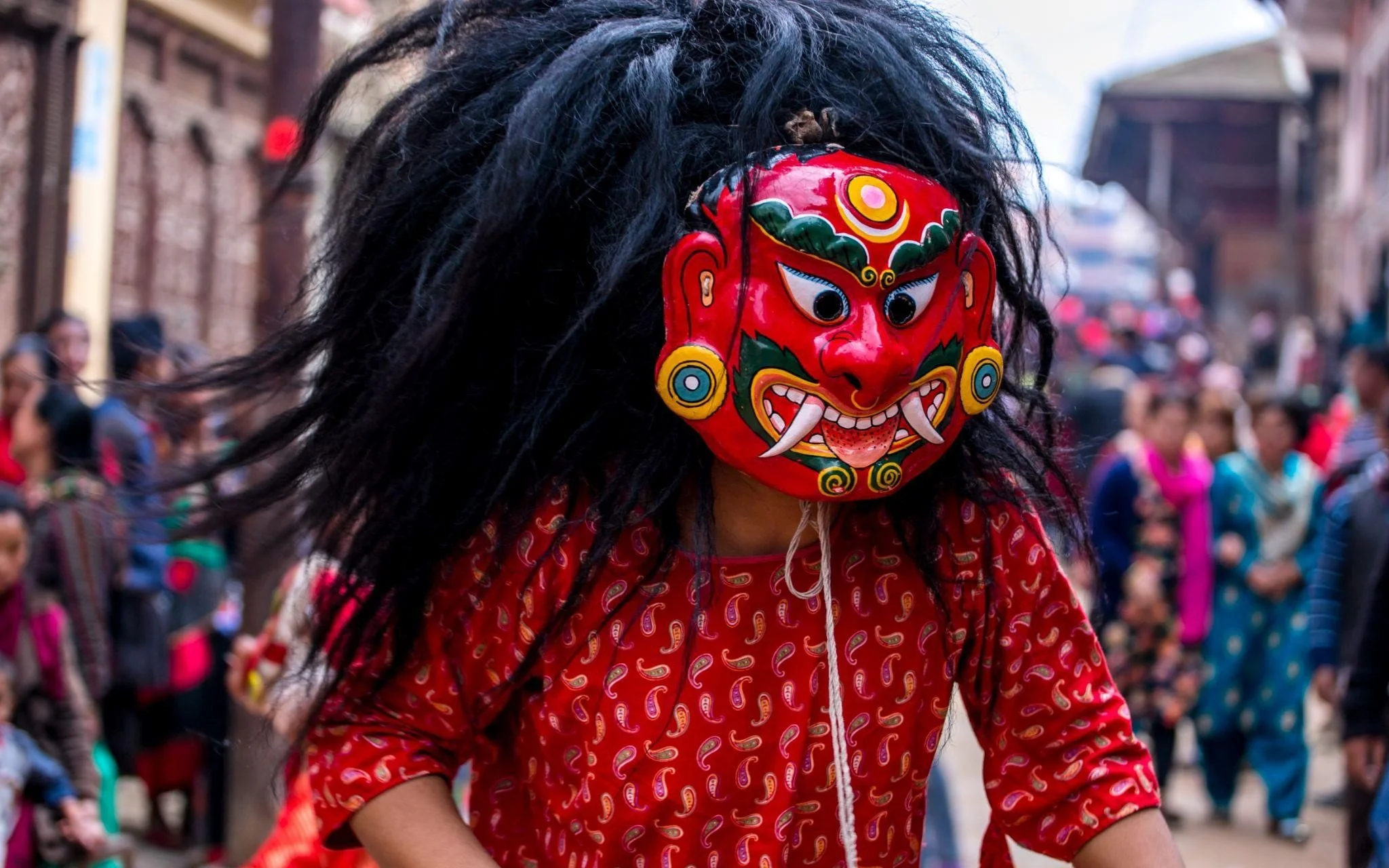
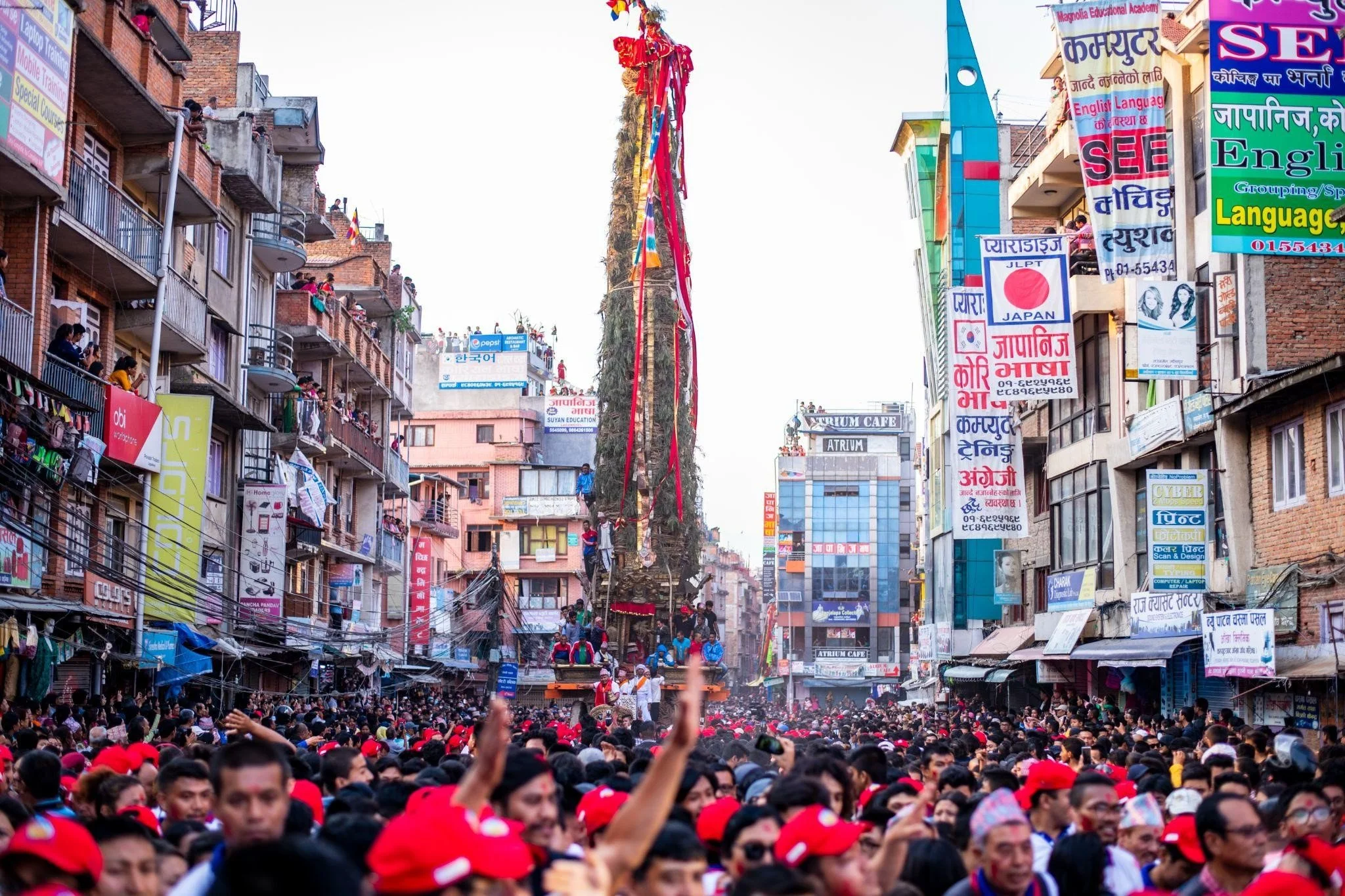
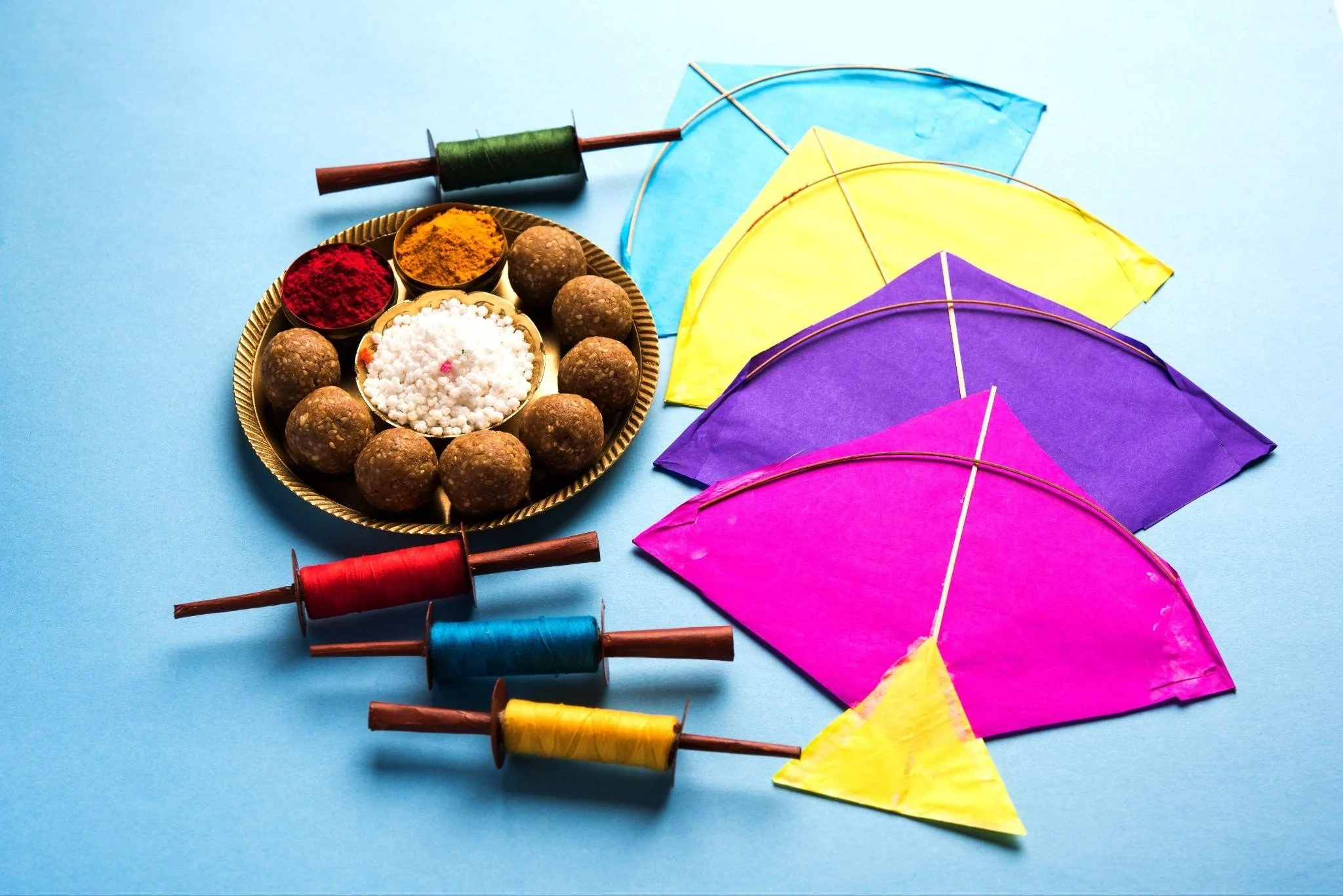

Festival of Colours in Nepal
The use of colours as a symbolic tool to mark joy and fanfare is a common tradition. It is used in various festivals throughout many cultures to symbolise festivity, joy and victory. In Nepal, two distinct festivals: Sindoor Jatra, and Holi have one thing in common; colours.
On the full moon day of Falgun, citizens of the Indian subcontinent rejoice in a unique festival known as Holi. The celebrations revolve around the age-old tradition of welcoming spring. It, along with Bisakh Jatra and Sindoor Jatra, are marked by the people of Kathmandu valley. They symbolise the end of winter and the beginning of the harvest season.
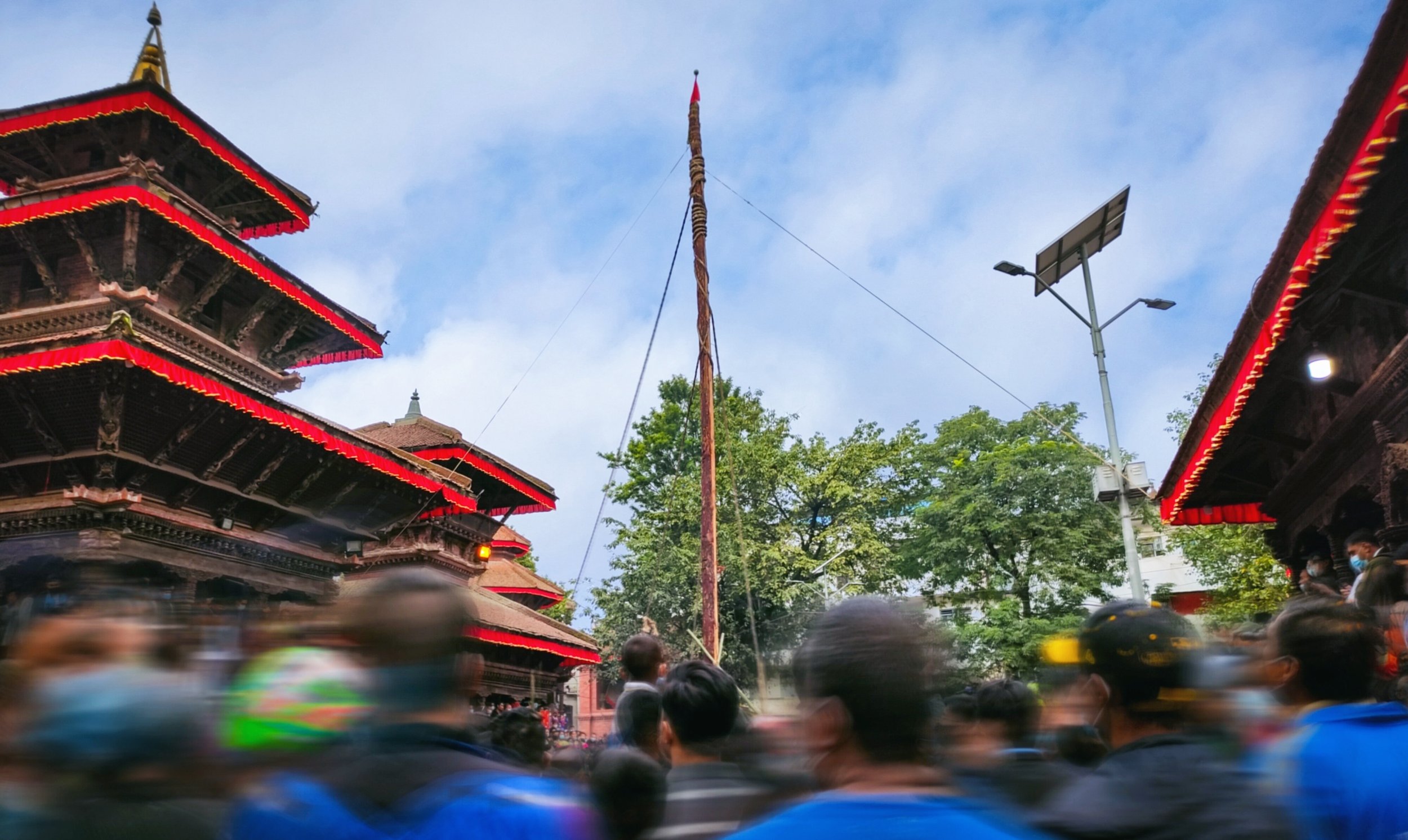
Over the years, Fagu Purnima has taken on many facets. Myths and folk tales help add mysticism and vibrancy to this day. In Kathmandu valley, a ceremonial pole known as Chir is erected in the lyakhu (palace) premises a few days before the full moon. It is decorated with vibrant coloured clothes by the people. Priests perform special rites, and devotees flock to receive blessings.
The process of erecting a wooden pole is not unique and exclusive to Kathmandu valley. The Maypole hoisted on May Day celebrations in Europe is an age-old tradition of festivity.
An interpretation of this day (Holi) revolves around a demon-king named Tarakasur. He ran rampant troubling the gods and causing problems. Tired and helpless, they concluded to consult Lord Shiva. But he was engaged in deep meditation after losing his wife, Sati Devi. The many gods of heaven planned on marrying Lord Shiva with Parvati, the daughter of the Himalayas. But they dared not to awaken the mighty Shiva. Thus they sought the help of Kamadeva, the god of love.
Kamadeva went to Kailash and shot a powerful arrow. It awakened Lord Shiva. To the surprise of all, he opened his third eye and shot a beam of light that burnt Kamadeva to ashes. As intended, the gods put forth the marriage proposal, which Lord Shiva accepted.
The ancients divided the year into two halves:
1. January to June (Longer days and shorter nights)
2. July to December (Longer nights and shorter days)
The second half belong to demons. During this part of the year, they are powerful and cause many troubles. As nights are longer, they terrify and conduct mischiefs. After the winter solstice, the sun begins its northern journey (Uttarayana), bringing an end to the demonic hold. Tarkasurs death came through the hands of Kartikeya, ending his tyranny. Coloured powder symbolises the victory of good over evil.
The second lore is of another demon king known as Hiranyakashyapu. His son Prahlada was a great devotee of Lord Vishnu. Numerous attempts to realign Praladha failed. Amongst these attempts was when Dhunda, the kings' sister, grabbed Praladha and jumped into a fire, she was blessed not to be harmed by fire. The intention was to burn Praladha alive, but Lord Vishnu saved him and burned Dhunda instead. She is also known by the name Holika, and connecting lore states the day got its name from this event.
King Hiranyakashyapus' end came through the hands of Narashingha, the lion avatar of Lord Vishnu. This act is the highlight of Kati Pyakhan (Kartik Naach), presented in Patan Durbar Square in the month of Kartik (October- November).
Click Here: To Read Our Article On Kartik Naach
Yet another tale goes as follows, Putana, a she-demon planned to kill Krishna. She hatched a plan and disguised herself as a mortal. She poisoned her milk and went to him. She allowed him to suckle her but failed to realise that he was not an ordinary child. He sucked Putana until she died.
All three stories revolve around attempts of evil and how the good is always victorious. We have developed various ways to commemorate this act. We play with colours (Holi), illuminate our homes (Dipawali) and share greetings and blessings (Dashain). We celebrate with our loved ones, visit temples, rejoice in various delicacies and share our affections with all.
Holi is celebrated for two consecutive days by Nepalese. The first day is a national celebration. Whereas, the second is Terai Holi which features robust fanfare in the Terai region of Nepal.
POPULAR ITINERARIES
SIMILAR POSTS

Kumari: The Tale Of The Goddess - Part III
There are many legends about the origin of how the Kumari Jatra tradition started. The most popular one is of King Jaya Prakash Malla, the last ruler of the Malla dynasty, which tells how the goddess Kumari vanished when the queen finds out to whom the King secretly visited every night.
The tale passed down from oral traditions goes as follows.
Continued…
He looked to her and asked, “Should I be worried about my neighboring kingdoms?”
She took the dice, and just as she was about to roll them, the door was bust open!
Armed guards surrounded the duo from every corner. The king felt confused, and just as he was about to speak, the queen entered the room.
“So, this is where you disappear to, MY KING!”
To which the king responded, “My beloved let me explain.” The king was interrupted by the queen, “DON’T! I find you in the late hours discussing state affairs with such a beautiful young woman!”
“But my love…” the king tried again.
“I can’t even leave you out of my sight for a moment!”
“Both of you… I had enough.” The attention of the room now shifted toward the beautiful young woman. Even the simplest of minds could have noticed that she is no ordinary mortal.
The room fell silent.
She gently placed the dice atop the board. She looked around the room: her sight reached the king’s eyes. She smiled.
She then looked to the queen, and that beautiful smile turned into a sharp look of authority.
In an instant, she threw herself up and spread her ten arms, eight of which held vessels of wielding power. An aura of flame emanated and surrounded her. Her gentle face turned frightening, and her third eye appeared.
Her nostrils flared, as she drew in deep breaths in anger.
She was no other than Taleju herself, revered as a wrathful aspect of Durga.
The soldiers dropped their weapons, and the queen drew back. The king was on his knees.
“HOW DARE YOU THINK OF ME IN SUCH A MANNER?”, she took in a breath and as she exhaled the aura of flame around her grew warmer. “Goddess, please forgive us! Please, I beg of you!” said the king.
“YOU HAVE SEEN THE LAST OF ME! I shall not stay in this kingdom any longer. You mortals and your jealousy, ENOUGH!”
“Goddess, please heed my cry! How would I reign without you?” appealed the king.
“You won’t! Your reign will soon come to an end, and your dynasty with it. For you and your brothers will unite for the last time. You shall fight alongside them, and it shall be your last.”
The flame grew larger and turned into a blinding streak of light. The Goddess had disappeared.
“I think your mission has now been accomplished?” said the king in a deep voice. “How should I have known, that it was goddess Taleju herself?” exclaimed the queen.
“You could have just minded your own business and leave me to mine.”
This night might have been the last but wasn’t the first time the king discussed state affairs with the Goddess. He had become so dependent on her advice, that after this incident: he lost all command to rule.
He kept his priests busy inside the Goddesses mammoth three-storied temple, making offering of all sorts; leaving no stone unturned. He prayed, heeded to her and waited anxiously.
Finally, the Goddess appeared but in a dream.
“Oh, my dear king, you’ve prayed more in these past few days, then many do in their entire lifetime. Your priests have been making offerings for days and nights. I will never forget the insult I suffered. But if you wish to see me again in mortal form, find a young virgin girl of the Bandya caste group. Choose the unblemished one, who exhibits thirty-two signs of perfection, for she will be my living manifestation, and your kingdoms living Goddess. Celebrate her, worship her as you worship me.”
The king awakened from his sleep. He joined his hands and thanked the Goddess. The morning that followed, he called in his ministry and his priests.
He instructed his priests to find the exact match and his ministers to put together the schematic to build her a beautiful home/palace. In the days that followed a young child from the Bhandya household who met all the criteria was found. She then was taken to the Taleju temple and in a special ceremony installed as the living embodiment of the Goddess.
To conclude this article, before king Jaya Prakash Malla, a living goddess sanctioned by the state was in the city of Lalitpur installed by Lichhavi king Laxmikamadeva. Over time, it is possible the tradition died out or took the form of a hidden cult. Many bahals and bahils of Nepal Mandala (Kathmandu Valley) have evidence of being the home of a living Goddess. The commonality among them is that embodiment of the Goddess has always been a girl from the Bhandya (Shakya and Bajracharya) caste group.
During the reign of Jaya Prakash Malla, he could have stumbled upon the hidden cult. Thus, he must have commissioned grotesquely introducing the tradition and have it sanctioned by the state in his kingdom of Kathmandu. We should keep in mind how, after king Yaksha Malla divided the kingdoms amongst his children: the Malla kings became rivals.
The merger of Goddess Taleju and the primordial Kumari of Nepal Mandala is an example of cultural assimilation. He took it further and build her a home/palace, and also introduced a chariot festival. It helped embolden the process and aided in creating the new identity of the primordial Goddess Kumari and her manifestation.
Today the three old Malla kingship states (Kathmandu, Lalitpur and Bhaktapur) have their customs and methods when it comes to caring for their living Goddess. They are one but different, but truly unique and primordial.
Correction:
In part I of this article, I mentioned she is called Dyah Meiju in Newari. Dyah means god and Meiju roughly translates to a noblewoman. It is also a word used to refer to a woman of the Bandya caste group.
POPULAR ITINERARIES
SIMILAR POSTS

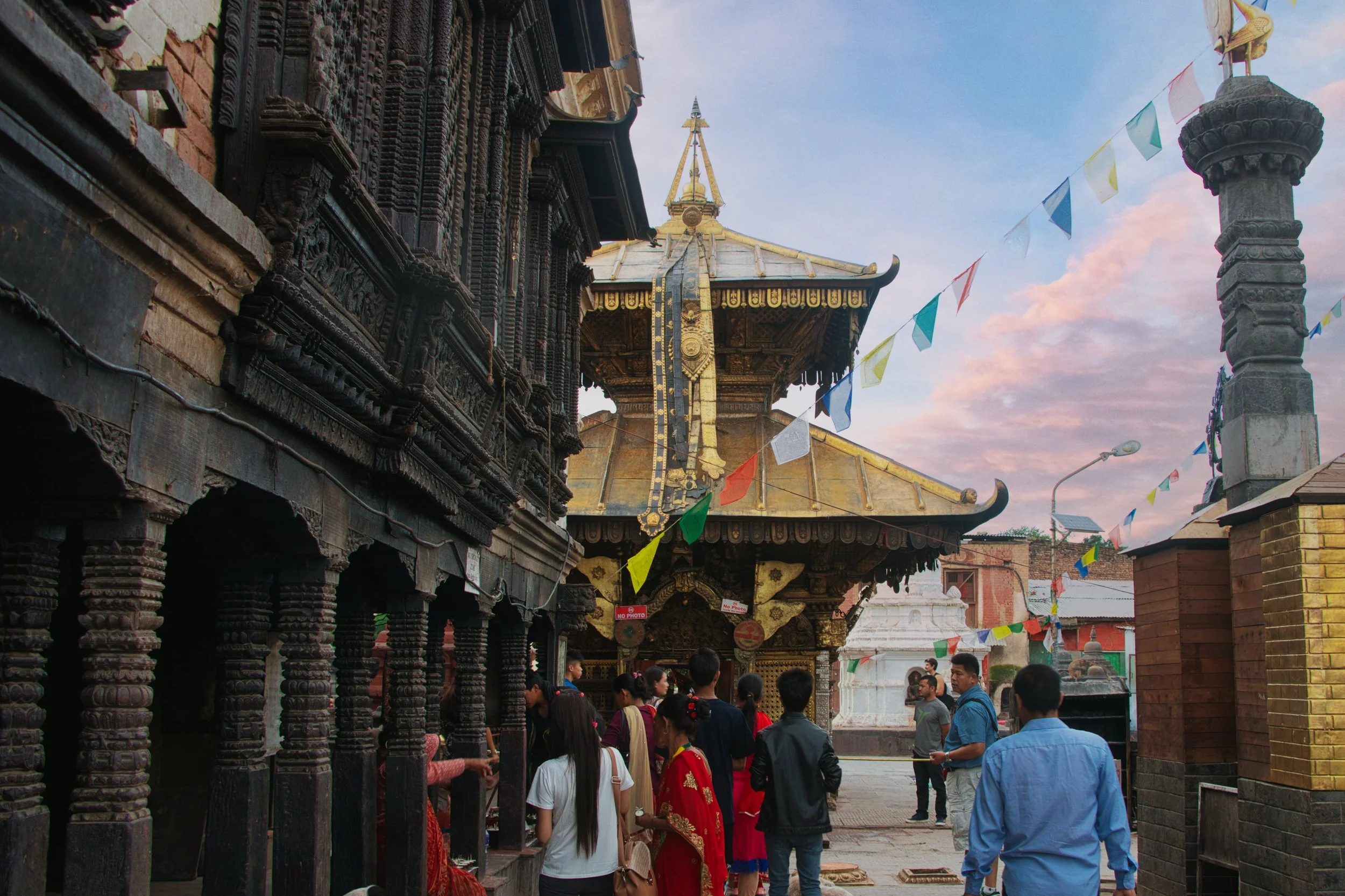

The Smaller Chariot Part II: The Legend of Min Nath
The Legend of Min Nath: smaller chariot paraded along the streets of Patan during Rato Matsyendranath festival worship dates back longer than of Rato Matsyendranath. Before the Rato Matsyendranath festival in Kathmandu, there use to be another chariot festival. A chariot of an idol, Min Nath or Karunamaya.
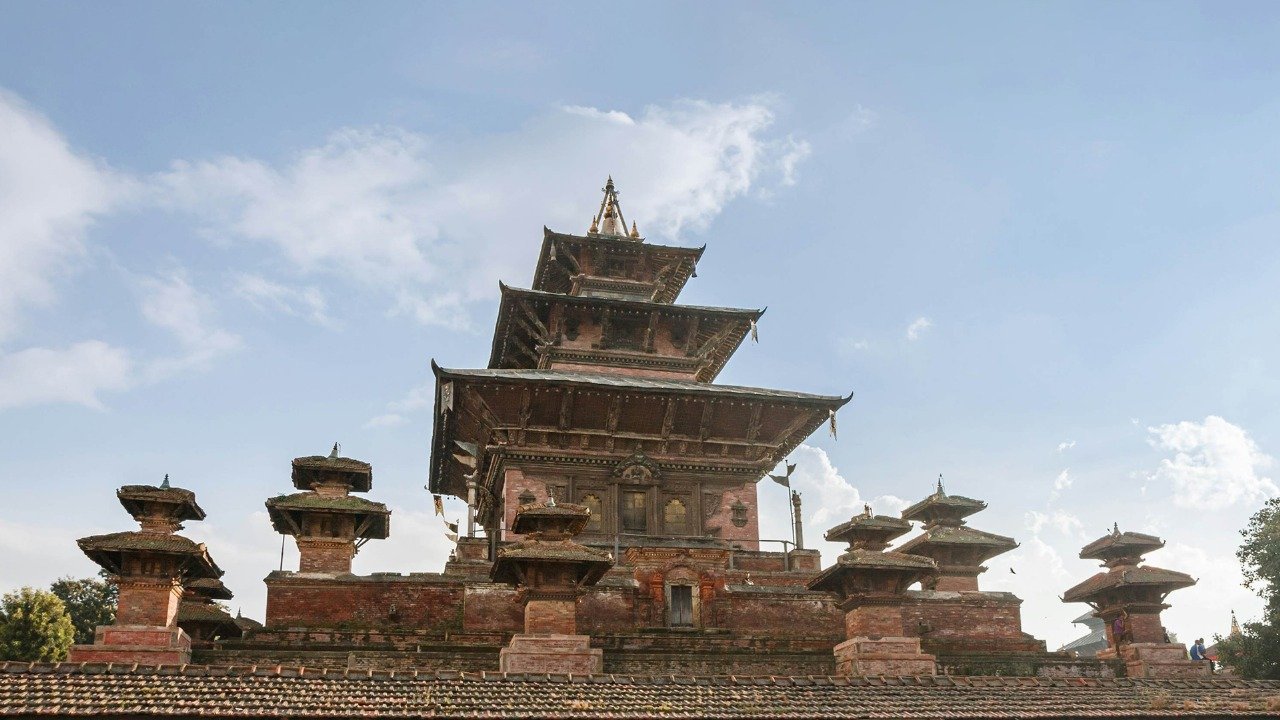
Seated in the smaller minaret styled chariot is an idol that over time has garnered many names. In the native dialect of Nepal Bhasa he is known as Chak: Baha Dyo (The god of Chak Baha in Patan of Lalitpur) and in Nepali as Jatadhari Lokeshwor ( Braided Hair Lokeshwor), but he is commonly called Min: Nath.
The legend of Min Nath passed down from oral tradition goes as follows.
Once there lived a pious king at Lagankhel of Matiligrama ( which was incorporated into the larger kingdom of Lalitpur), who was named Brisha Deva. His daily routine featured a walk to visit a nearby Buddhist stupa. He used to circulate the stupa several times reciting sacred prayers. One day during the process, he suddenly died!
His body laid there, waiting for last rites, whereas his soul had been brought to Yamaloka ( the land of the death) by Yama Dutas. He was placed before Min Nath, who is also known as Dharmaraj. It is him (Dharmaraj/ Min Nath) who decides what is right or wrong with the dead.
King Birsha Deva found the land enchanting. He heard the soothing sounds of the Gandavyuha- Sutra ( A sacred Buddhist scriptures) and saw how the God of Mercy ( Min Nath) treated those who suffered by squeezing water from his wet braided hair. For which he is also called Jatadhari Lokeshwor ( Braided Hair Lokeshwor). Now came the turn of king Brisha Deva to be inspected by Min Nath.
Upon a thorough inspection, he (Min Nath) told his messengers (Yama Dutas) that it is still too early to fetch king Brisha Deva and to take him back to his own home.
King Birsha Deva returned to his place. His lifeless body slowly began to move and he came to life.
The king was highly impressed by the spiritual atmosphere of Yamaloka and thus conjured a plan to recreate the same scenic setting in his kingdom. He requested master artisans to create a beautiful image of Min Nath and introduced the practice of reciting Gandavyuha- sutra.
Thus was born the cult of worshipping Min Nath.
When king Birsha Deva finally did pass away, his brother Balarchan Deva ruled in Matiligrama.
One night king Balarchan Deva had a dream in which Min Nath told him, "O king when you shall awaken, you will see a bird flying towards a particular place. Build a beautiful home for me at the spot where the bird alights."
When the king awoke, and he reached out to his astrologers, they unanimously stated that the dream was an auspicious one.The king built a monastery, the first of its kind in Matiligrama at a site where he saw a bird perching atop a tree. The monastery was named Jesthaverna Maha Bihar, meaning the first-ever monastery. The image of Min Nath was enshrined at the Bihar, and the tradition of a chariot festival was instituted.
When the trio of King Narendra Deva, with priest Bandhudatta and Rathacakra Jyapu, returned with Karunamaya and decided to institute a chariot festival, they wished for there to be only one chariot festival in Lalitpur.
But the unified kingdom of Lalitpur had seven chariot festivals.
It is said that six of the seven gods agreed to discontinue their chariot festival in honour of Karunamaya, but Min Nath wished different. Priest Bandhudatta tried his best to bring Min Nath to his control, but he failed.
After which Min Nath, opened his third eye and projected a beam of light which hit a small stupa outside the Baha gate. Another variation, states he threw a bajra ( lighting bolt). The stupa is still present at the premises and seems to have been hit by a strong force.
Thus, the chariot festival of Min Nath was not assimilated into that of Karunamaya, allowing the cult of Min Nath to continue and develop its own identity.
A schematic for a combined procession was created featuring two chariots, one of Karunamaya and the other of Min Nath. In honour of the other six gods and their chariot festival, they were incorporated into the chariot of Karunamaya, accordingly.
For almost two millennia and more, the chariot of Karunamaya has made its way through riveting terrain and waited at Jhana Ko for Min Nath. It has in time become not just a chariot festival but the identity of the city and the valley of Nepal Mandala ( Kathmandu Valley).
It has grown as a symbol of religious and cultural unity, with worshippers of multiple religious sects bestowing prayer and worship to the God of Compassion ( Karunamaya) and the God of Mercy (Min Nath).
POPULAR ITINERARIES
SIMILAR POSTS

The Smaller Chariot - Part I: The Legend of Min Nath
A smaller chariot pulled by children and young adults embarks from the heart of the city, to welcome Karunamaya. According to oral traditions, being the elder god of Lalitpur without his permission, Karunamaya cannot enter the city. Thus, Chak Baha Dyo comes to the outskirts of Lalitpur to ceremonially welcome Karunamaya.
Marked as the longest chariot festival in Nepal, Rato Matysendranath Jatra needs no introduction. The five-storey chariot has over time, become a symbol of cultural unity in the diverse scape of Kathmandu Valley. But little is known about the smaller chariot which leads and later follows Matysendranath also known as Karunamaya in Nepal Bhasa through the old routes of Lalitpur.
Seated in the smaller minaret styled chariot is an idol that over time has garnered many names. In the native dialect of Nepal Bhasa he is known as Chak: Baha Dyo (The god of Chak Baha in Patan of Lalitpur) and in Nepali as Jatadhari Lokeshwor ( Braided Hair Lokeshwor), but he is commonly called Min: Nath.
Tracing chronologies, research articles, oral tales and pieces of evidence; the worship and chariot festival of Chak: Baha Dyo dates back longer than of Rato Matysendranath. Before the formation of Lalitpur by King Bir Deva, the area featured multiple settlements such as Mati Rajya/ Matiligrama (Later Matilinagar), Yupagarma, Irshya Rajya and Dipavati. The city of Lalitpur was fashioned out of the merger of existing settlements and re-arrangement of principle locales and households.
“In this King’s time chariots were made for the following gods and the custom was established of having the people celebrate their festivals in the various localities of Lalitpattana from Baisakh Sukla 11 until the full moon: Matilinagar’s Minnath- Jatadhari Lokesvara, Dhalaksha;s Lokanath, Matilinagar’s Batuk Bhairav, Satha’s Naryana, Calalse’s Harisankar, Kolima’s [ Kulimha’s] Mahesvara..” - (Gellner, D. No. 1996. “ A sketch of the history of Lalitpur with special references to Buddhism.” CNAS Journal: 128
It was during the reign of his grandson King Bara Deva, Nepal Mandala (Kathmandu Valley) faced an acute famine. To relieve it King Narendra Deva ( father of King Bara Deva, who had left worldly affairs to live in a monastery in Bhadgeon), along with priest Bandhudatta and Rathacakra Jyapu left for Kamakhya in Assam to seek Karunamaya. The trio returned victoriously!
A chariot festival was instituted in honour of Karunamaya, which still makes its way through the inner routes of Lalitpur from the month of Baisakh. To anyone who has witnessed this festival cannot help but marvel at the joyous revelling, magnificent chariots, splendid tunes of Newa communities and the organized chaos of the festival, it is truly a sight to behold.
During the first day of the chariot festival, Karunamaya’s chariot is pulled some 400 metres and placed adjacent to Pucho: Thur ( Pulchowk Stupa). A special rite is conducted and revellers look on east-ward.
A smaller chariot pulled by children and young adults embarks from the heart of the city, to welcome Karunamaya. As Chak Baha Dyo’s chariot reaches a few hundred metres from Nya Tole ( Na: Tol), both idols face each other. According to oral traditions, being the elder god of Lalitpur without his permission, Karunamaya cannot enter the city. Thus, Chak Baha Dyo comes to the outskirts of Lalitpur to ceremonially welcome Karunamaya.
The chariot of Rato Matsyendranath is constructed at the outskirt of the city. The place is currently known as Pulchowk but was previously called Rath Khel, Rath meaning chariot and Khel an open field. Whereas the chariot of Chak Baha Dyo, since the inception of the festival is constructed right outside the bahal premises. Both chariots today, feature similar principles of construction but it is believed that before bringing Karunamaya into Nepal Mandala, the chariot of Chak Baha Dyo had a different design.
Major differences among the two chariots are their height and design of biman kha (the space where the idol is placed). Apart from which, both idols feature four wheels representing four Bhairavas, an elongated piece of wood known as Dhoma (God Wood), and pinnacle architecture topped by a circular base known as Byama.
Annually the chariot festival takes the same route. The chariot of Rato Matsyendranath makes its way from Rath Khel (Pulchowk) to Jhana Ko ( Near Pulchowk Stupa). Whereas the smaller chariot, leaves from Chak Baha ( locally known as Tangal) through Mangha (Mangal Bazar), Mah: Pal, Ga: Bahal and reaches Nya Tole ( Na Tole). After which, the smaller chariot makes a turn and proceeds towards Ga: Bahal and the other chariot follows.
During the second day of the chariot procession, the chariot of Chak Baha Dyo gives way to the chariot of Rato Matsyendranath to take the lead. Both chariots rest at the heart of the city, Mangha ( Mangal Bazar). In designated days, they are pulled towards Sundhara, Thapa Hiti, Laga Khel (Lagan Khel), Tha: Ti, It: i and on the final day the chariots are pulled to Ja Hwau Khel / Jawalakhel ( Ja meaning rice, Hwau; to feed in a throwing gesture and Khel an open field).
POPULAR ITINERARIES
SIMILAR POSTS

A Guide To Newari Festivals - Part VI
Newari communities in Nepal celebrate numerous festivals every year. All these festivals are tied to its culture and heritage, events for ancient mythology, agricultural calendar, family, and communities.
Jana Baha Dyo Jatra
Celebrated In: March*
Commonly known as Seto Matsyendrath, it is natively known as Jana Baha Dyo, Yalameshwor. The chariot procession is marked for Chaitya Dashain, and the building process is commenced a week prior. A group of traditional builders with the help of volunteers build the 4 storied chariots shaped in Shikhara architecture.
The chariot makes its way through various parts of the old routes of Kathmandu. The chariot is pulled within 3 days and on the third day a special puja is conducted after which the image of Jana Baha Dyo is taken back to the temple at Jana Bahal.
The chariot makes it’s way from Durbar Marg to Bhotahity and rests in Asan on the first day. After which it is pulled to Ket Tol, Indra Chowk, and rests in Hanuman Dhoka. On the final day, it makes its way through Basantapur Durbar Square, Jasidega and circles the mother tree three times in Lagan.
Learn More About Jana Baha Dyo Jatra: The Chariot Festival of Seto Matsyendranath
Biskah Jatra
Celebrated In: April*
Biskah Jatra which is commonly known as Bisket Jatra is a festival which is celebrated according to the solar calendar (Bikram Sambat) rather than the lunar Nepal Era Calendar. It is derived from the word, “Bee Sikah”, which means ‘after the death of the serpents’. The festival is centred around the worship of the deities Lord Bhairav and Goddess Bhadrakali. The festival lasts for a total of 9 days from the 27th of Chaitra to 5th of Baisakh.
A procession of two chariots, being pulled in a tug-of-war setting between Thane(Upper) and Kone(Lower) part of town begins the festivities of Biskah Jatra. Two lingo’s known as Yo Shi (55-feet-tall each) are erected in two different locations of the central city on New Year’s Eve and brought crashing down on New Year’s Day symbolizing the killing of the serpents. To symbolize the consummation of the marriage, the two raths (chariots) are made to crash against each other. This occurs during midnight when the Bhairab and Bhadrakali chariots are collided symbolizing copulation.
Learn More About Biskah Jatra Here: Tales Of Biskah Jatra
Bunga Dyo Jatra
Celebrated In: April-May*
Dubbed as one of the longest chariot festivals of the world, the Bunga Dyo Jatra holds huge importance in the Newar Pantheon. Also known as Rato Matsyendranath, the festivals origin dates back to the Lichhavi era.
The chariot festival commences a day after Mata Tirtha Ausi ( National Mothers Day) when the idol of Karunamaya is placed onto the chariot which is built at Pulchowk of Lalitpur. The elements of the chariot hold multiple significance in regards to the journey of bringing Karunamaya into the valley. The chariot is pulled by revellers on the fourth day after it is placed in the chariot. It makes its way through the ancient routes of Patan and ends in Jawalakhel after which the Bhoto (Vest) is displayed. After which the idol of Karunamaya is taken home to Amarpur (Bungamati) where it spends the next six months, after which a few weeks before Yomari Punhi the idol is brought to Patan and placed at Ta Bahal of Lalitpur.
Locally known as Bunga Dyo, the deity is also known as Karunamaya Lokeshwor who is regarded as the deity of compassion according to Buddhism. In local significance, the deity is the patron deity of Bungamati thus the name Bunga Dyo. The farmers of the Nepal Mandala ( The Valley Kingdom of Nepal) worship the Bunga Dyo as the god of rain.
Learn More About The Chariot Festival Here: The Festival of Rato Matsyendranath
Learn More About The Bhoto Here: The Legend Of Bhoto Jatra
Swanya Punhi
Celebrated In: May-June*
The day of Buddha Jayanti is known as Swanya Punhi in Nepal Bhasa. This day is celebrated as the day of birth, enlightenment and death of Lord Buddha, who is regarded as the light of Asia. Devotees and worshippers take special pilgrimages to various Buddhist sites, monuments, monasteries in and around the valley.
Sithi Nakhah
Celebrated In: June*
The festival of Sithi Nakhah is the last in the festive calendar of the Newar people. It is a festival that is dedicated to Lord Kumar, which falls on the sixth day of the bright lunar fortnight. Kartikeya Kumar is traditionally known as Sithi Dyah in Nepal Bhasa. It is believed that he was born on this day. Devotees take a holy bath and also clean their households on this day. Various public areas such as well's, conduits, pathi’s and pauwa’s are cleansed on this day. Households prepare Chatamari- a typical Newari delicacy made from rice flour crepe along with which Wo- which is a flat cake of black lentils.
*: As Newar festivals are celebrated according to the lunar Nepal Era calendar, the dates in the Gregorian calendar are interchangeable.
POPULAR ITINERARIES
SIMILAR POSTS

A Guide To Newari Festivals - Part V
Newari culture is very rich and ritual throughout the year and the Newari communities celebrate numerous festivals every year. All these festivals are tied to its culture and heritage, events for ancient mythology, agricultural calendar, family, and communities.
Ghayh Chaku Sanhlhu
Celebrated In: January*
Commonly known as Maghe Sankranti, Newar households celebrate this day as Ghayh Chaku Samhlhu where Ghyah means Ghee (Clarified Butter) and Chaku which is molasses in Nepal Bhasa. This festival is observed according to the solar calendar of Bikram Sambat (B.S), rather than the traditional lunar calendar. This day begins with people taking a holy bath at the crack of dawn, which is followed by special worship.
Households prepare special delicacies such as yam, spinach, sesame candy and molasses which is consumed with the additions of ghee, ginger, and beaten rice. This day is also marked as the winter solstice, and consumption of the aforementioned foods helps warm their bodies.
Read more on the delights of Maghe Sankranti: Feasts of Maghe Sankranti
Swasthani Bakhan Kanegu
Celebrated In: January to February*
During the month of Magh, from Mila Punhi to Shi Punhi in the Nepal Era calendar, Swasthani Bakhan ( Tales of Swasthani) is recited every evening during this month. Devotees visit the Swastani temple in Sankhu and take a holy dip in the Sali Nadi, along with various other rivers. It is generally believed that worshipping Swasthani brings forth happiness, and well being in life.
Read more on Swasthani: Swasthani Bratakatha Festival In Nepal
Shree Panchami
Celebrated In: February*
Shree Panchami also is known as Basanta Panchami is regarded as the day when winter ends and spring begins. The day is centred around the worship of Goddess Saraswati, who is regarded as the Goddess of Knowledge. During this day children are taken to the nearest Saraswati temple to take blessings. A tradition during this day is to write something, on the walls in the vicinity of the temple. Buddhist households worship Lord Manjushree on this day.
Sila Charhre
Celebrated In: March*
In the lunar calendar of Nepal Era, there are a total of 24 nights dedicated to Shiva, which is commonly known as Shivaratri. Amongst all the days of dedication, Sila Chahre is celebrated as the main night. This day is also referred to as Maha Shivaratri. This day honours Lord Shiva who is known as “The Destroyer” within the Trimurti.
This festival is marked to “Overcoming darkness and ignorance”, for which Lord Shiva is remembered. Devotees on this day fast, pray and meditate and visit various Shiva temples in their vicinity. Believers from all over the world, make a special pilgrimage to the temple of Pashupatinath in Kathmandu to offer their prayers and worship.
To learn more about the temple of Pashupatinath: UNESCO World Heritage: Pashupatinath
To Learn more about the legend: The Legend of Pashupatinath
Holi Punhi
Celebrated In: April*
Also known as “The Festival of Colour”, Holi is celebrated as the coming of spring. The beginning of the festival is marked by raising a ceremonial pole known as Chir in Basantapur of Kathmandu. The Chir features, clothes of various bright colours to symbolize the coming of the month of spring. People celebrate this occasion by offering colours to each other and having a feast.
Learn More About Holi: The Coming of Spring- Falgun Purnima
Pahan Chahre
Celebrated In: April*
Pahan Chahre is a festival that is specifically observed in the Kathmandu valley. It is also known as Pasa Charhe, where Pasa means friends. Celebrated for a total of 3 days, the first day sees the worship of the deity Luku Mahadyah (Lord Shiva). The second day is Dyah Lwakegu which is celebrated at the open field of Tudikhel in the evening. This day also coincides with the annual Ghode Jatra. On the final day, a grand celebration occurs at Asan of Kathmandu. The palanquins of Lumadhi Ajima (Maheshwari) also known as Bhadrakalai, Kanga Ajima (Varahi) and Tebhana Ajima (Chamunda) are paraded in the streets.
Newar households of Kathmandu invite their neighbours, extended families and friends for a grand feast to commemorate this day.
Learn more about Pahan Charhe: Pahan Charhe- Festival in Nepal
*: As Newar festivals are celebrated according to the lunar Nepal Era calendar, the dates in the Gregorian calendar are interchangeable.
POPULAR ITINERARIES
SIMILAR POSTS

A Guide To Newari Festivals - Part IV
Svanti festival is known by several names: Tihar, Dipawali, Pancaka, and Yamanpanchaka. And most popularly known by its other name Tihar, is one of the national festivals of Nepal celebrated throughout the kingdom by Hindu and Buddhist populations.
Svanti
Celebrated In: October*
“Svanti is one of the national festivals of Nepal celebrated throughout the kingdom by the Hindu and Buddhist population. This festival is known by several names: Svanti, Pancaka, Yamapancaka, Tihar and Dipavali. Both the words ‘Tihar’ and ‘Dipavali’ are derived from the Hindi words ‘Tyauhara’ and ‘Divali’. Svanti, Pancaka and Yamapancaka are words from Nepalese origin (Naghabhani 1991:30).“
Svanti is derived from Swanhu Tithi (three auspicious days). Whereas Yamapancaka means ‘ Five days dedicated to Yama’.
“During this festival, Yama, the god of death is invoked and so it is called ‘Yamapancaka’. People assume that during these five days, Yama descends on this world. On the first and second day of this festival, Yama’s messengers, the crow and the dog are worshipped. On the third day, the cow is worshipped. Although the cow is worshipped as Lakshmi, the goddess of wealth, she is also respected as an animal associated with the realm of Yama. Yama’s assistance is sought in order that recently deceased people may cross the river Baitarani to reach heaven. Honouring Yama and his messengers Yamadut on the day of Mhapuja and worshipping Yama and his bookkeeper Citragupta on the day of Kijapuja clearly mark the relation of this festival to death.”1
This direction of the celebration of Svanti weakened over time, as it took on the facets of Tihar and Dipavali with the worship of Goddess Lakshmi, initiation of Bhai Tika and the overall view of the celebration as “Festival of Lights”.
“Although Yama is invoked on each of the live days during this festival, many people disagree with the name "Yamapancaka" because the lofty ways of celebrating Laksmi, the worship of the self, and the worship of brothers have weakened the worship of Yama considerably (Naghabhani 1991: 47)”
Today in the modern Newar household, Svanti is celebrated for a total of five days:
Kva Puja: Worship of crows, messengers of death;
Khicapuka: Worship of dogs;
Sa Puja and Laksmi Puja: The worship of cows and Goddess Laksmi, the goddess of wealth;
Mah Puja: The worship of the self and beginning of New Year in Nepal Sambat Calendar; and
Kija Puja: The worship of brothers by their sisters.
Saki Mila Punhi
Celebrated In: November*
Saki Mila Punhi, also known as Saki Manā Punhi is the full moon of the Newar month Kachhala. Saki stands for Taro and Mana means to boil. Thus on this day households prepare boiled taro/arum along with sweet potato. Halimali which are sacred art made from puffed rice, corn, wheat and black soybean which are exhibited in front of temples accompanied by Dapha Bhajan or Dhalcha Bhajan (chanting religious hymns).
Bala Charhe
Celebrated In: December*
Commonly known as Bala Chaturdashi, this day sees family members of the Newar Households scatter seeds (sadhbew) and pray for the souls of the departed in Pashupati of Kathmandu.
Yomari Punhi
Celebrated In: December*
Traditionally Newar Households, feature a majority population of farmers. They sow their seeds pre Gathamugah and post collect the harvest of the season. During the full moon of the month, the households celebrate Yomari Punhi. It is a post-harvest festival of worshipping Goddess Annapurna, also known as Angsa Maru Ajima located at Asan of Kathmandu. Various temples dedicated to Goddess Annapurna all over the valley, feature devotees offering prayer, worship and thanking by presenting the fruit of the first harvest, “Yomari.”
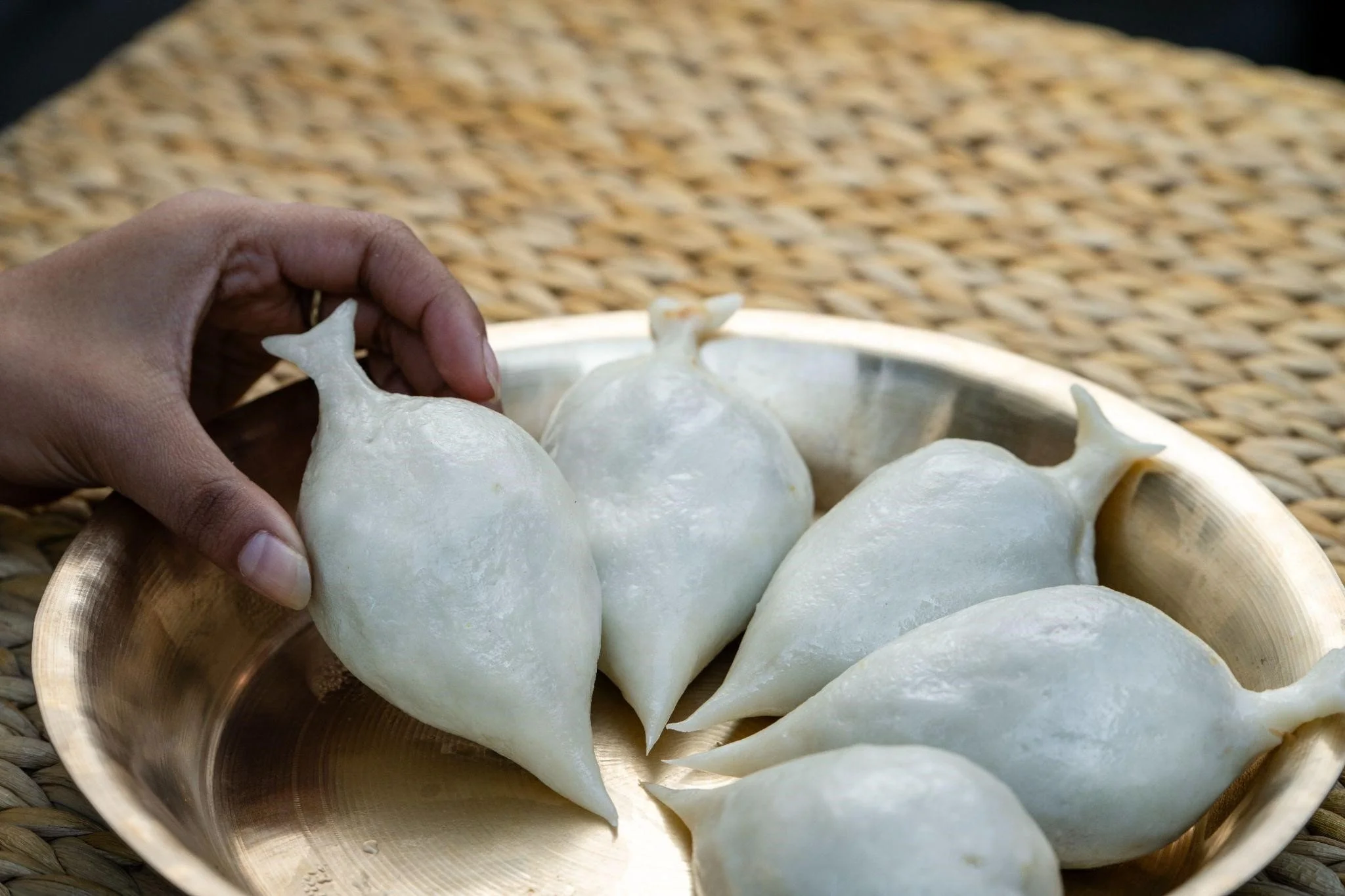
The full moon takes its name from Yomari which is a steamed rice cake filled with molasses, locally known as Chakku. Households offer prayer, worship and place a Yomari in the Dhukoo (Grain Store Room). Communal celebrations see parades of children and young go door to door with traditional music. They are offered grain, Yomari and money by the households.
Learn more about the origin of Yomari: Yomari Punhi
*: As Newar festivals are celebrated according to the lunar Nepal Era calendar, the dates in the Gregorian calendar are interchangeable.
POPULAR ITINERARIES
SIMILAR POSTS

A Guide To Newari Festivals - Part III
The events of Mohani can be divided into two: Family & Communal and bears similarities with the celebration of Dashain. And, the general perception of individuals views the two festivities as the same, but Mohani is specific to the Newari communities. Mohani is centered around the family’s tutelary deity, whereas Dashain is the celebration of the victory of gods over evil.
Yenya Punhi
Celebrated In: September*
Yen denotes Kathmandu and Ya means celebration according to Nepal Bhasa, the language of the Newar people. Yenya Punhi is the beginning of “The Celebration of Kathmandu”, and is marked by masked dances ( Lakhey Aju, Dee Pyakhan, Sawa Bhaku, Phulukushi, Mahakali Naach), idols of Indra displayed at various points in the old city, along with Bhairav’s of Kathmandu (Swet Bhairav, Aakash Bhariav and Baka Bhairav), the tableau of Das Avatar is shown near Kumari Chhen (Kumari Home) and is highlighted by the chariot festival of the Royal Kumari of Kathmandu. Her chariot is followed by the chariots of the Living Ganesh and Bhairab which circumvents the old routes of Kathmandu in three days.
To know more about Indra Jatra: The Festival of Indra
Mohani
Celebrated In: October*
Amongst the numerous Newar festivals, Mohani is considered as the most important. Lasting for a total of 2 weeks, main celebrations, however, occur from 8th to 11th day of the lunar Nepal Era Calendar (Nepal Sambat).
The events of Mohani can be divided into two: Family & Communal and bears similarities with the celebration of Dashain. The general perception of individuals views the two festivities as the same, but Mohani is specific to the Newar community whereas elements of Dashain were introduced with the arrival of Hinduism brought by Lichhavi’s and Malla’s. Dashain in Hinduism signifies the victory of Goddess Durga over Mahisasur, Goddess Chamunda destroying the demon Chunda. Whereas in the Newar celebration of Mohani it is centred around the family’s tutelary deity.
The celebrations begin on fortnight with the planting of Barley seeds in an earthen bowl on the sand. The bowl is placed in the shrine room or Agam Chhen (God House) which is where families place the tutelary deity. This process is known as Nalaswane and has the seeds be placed in the room for a total of nine days. Eight days from the fortnight is known as Astami, on this day Kuchhi Bhoya is held. Members of the family sit in a row for a feast which encompasses two mana i.e roughly two kilograms of beaten rice. The eldest takes the place of honour at the top and the youngest at the bottom. The next day is known as Syakwa Tyakwa which falls on Navami, which is the ninth day of the fortnight in the lunar calendar. During this day, special rituals are performed in the shrine room of the tutelary deity of the household. Various tools of the household and trade are cleaned and a special offering is made to them.
Individuals also get an opportunity to visit the sacred temple of Taleju Bhawani, who is the tutelary deity of the old Malla King’s of Nepal.
The final day is known as Chala, which occurs on Dashami, the tenth day of the fortnight. The Nalaswan shoots are taken out of the shrine room and placed in the family worship Thali (Plate). A special service is commenced at the Agam Chhen, after which members of the family take blessings from their elders. They are offered a sacred red tika ( Vermilion, Rice and Yoghurt) and a black tika which is also known as Mohani Tika. This colour is only utilized during the celebration of Mohani. This is followed by a Ko: Kha (a red shredded piece of cloth) which is tied on the neck. In cases where the household has lost a family member, all the ritual celebrations are omitted in the core home, and the elders are called onto the homes of the married daughters where they offer blessings with a yellow and black tika. During the evening, families prepare for a special ceremony known as Paya. A circular ash ground is painted to symbolize the demon and is chopped in full force by members of the family with their families ancient weapons.
Communal celebrations of Mohani, are centred in various parts of Nepal Mandala. The ceremony of Paya is conducted on a communal scale in most parts of the city, which takes the outlook of a procession with scimitars. Examples of which are the Mahalaxmi Paya in Patan and Khadga Jatra in Bhaktapur. On the fifth day of the fortnight, of the lunar calendar, the procession of Pachali Bhairav is conducted. The region of Kokhana has a unique celebration during this period known as the Sikali Jatra. The Navadurga Naach (Dance) is displayed in various locales of Bhaktapur, and central Patan indulges in Ga Pyakhan (Dance of Gods).
*: As Newar festivals are celebrated according to the lunar Nepal Era calendar, the dates in the Gregorian calendar are interchangeable.
POPULAR ITINERARIES
SIMILAR POSTS

A Guide To Newari Festivals - Part II
Newari communities in Nepal celebrate numerous festivals every year. And it seems Newars always have a reason to celebrate. Several reasons: rich culture and heritage, honoring deities, marking the agricultural calendar, celebrate events from ancient mythology, and to emphasis family and community.
At times it does feel true, we the Newar people seem to always have a reason to celebrate.
The Newar people also are known as Newa in Nepal Bhasa are the historical inhabitants of the Kathmandu Valley and its surrounding territories and states. This region was historically called Nepal/ The Valley Kingdom of Nepal (Nepal Mandala). The history of this land can be divided into two: Ancient and Modern Nepal. The transition occurs after the unification campaign of Late King Prithvi Narayan Shah who is also known as the founder of Modern Nepal.
The Newar/ Newa people sociologically classified as an ethnic group. As they have their language (Nepal Bhasa), calendar( Nepal Sambat), behaviour, custom, tradition, cuisine, territorial association and heritage. Newars feature a set of diverse ethnicities who follow Hinduism and Buddhism.
“The Kathmandu Valley and surrounding territories constituted the former Newar kingdom of the Nepal Mandala. Unlike other common-origin ethnic or caste groups of Nepal, the Newars are regarded as an example of a nation community with a relict identity, derived from an ethnically-diverse, previously-existing polity. Newar community within it consists of various strands of ethnic, racial, caste and religiois heterogeneity, as they are the descendants of the diverse group of people that have lived in Nepal Mandala since prehistoric times. Indo- Aryan tribes like the Licchavis and Mallas (N) form respective Indian Mahajanapada (I.e Licchavis of Vajji and Malla(I)) that arrived at different periods eventually merged with the local population by adopting their language and customs. These tribes however retained their Vedic culture and brought with them their Sanskritic languages, socials structure and Hindu religion, which was assimilated with local cultures and gave rise to the current Newar civilization. Newar rule in Nepal Mandala ended with its conquest by the Gorkha Kingdom in 1768.” - Wikipedia
Saparu
Celebrated In: August- September*
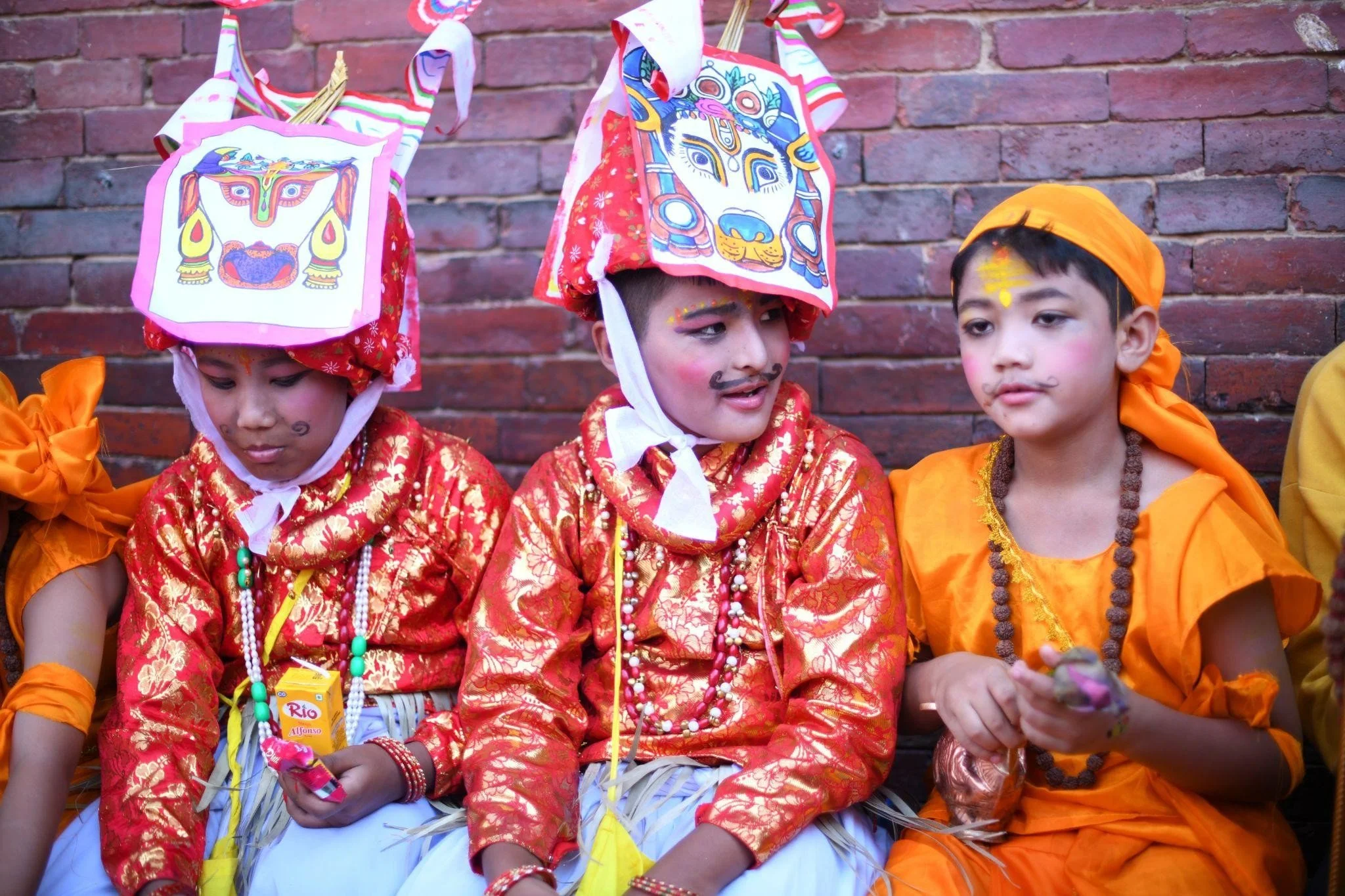
The second day is known as Saparu, which in the local terminology is known as Gai Jatra. The day sees members of the family who have lost a member of their family during the past year, dress up in traditional outfits and parade around the city. Some households also parade cows during this day. Members of the Newar community also make a holy pilgrimage to the lake of Gosaikhunda, leaving to reach the lake on the day of Saparu. This is believed to help rid one's soul of past sins and foul.
Saparu is celebrated in various communities with each community having a different take. One of the most notable celebrations is conducted in the city of Bhaktapur. It draws an ample crowd to witness the community create humour and satire which is a traditional process created to uplift the spirits of the members of families who have lost a family member during the past year. In Patan, Matya is celebrated a day after Saparu, during when devotees make a holy pilgrimage to the various sites, temples and monuments in the core city of Patan. With over 3000 such sites, Matya is not an easy affair. Individuals clad in a special uniform carrying candles, or dress up as comical characters to help create an environment of laughter and joy. Devotees are generally members of households who have lost a family member or devotees who wish to partake. As no restrictions are placed even enthusiasts of national and international decent join in this holy pilgrimage.
The last day of Gunhu Punhi is Krishnastami, celebrated as the day of birth of Lord Krishna an incarnation of Lord Vishnu. Various micro festivities are conducted in all vicinities of the Newar communities such as Narsingha Yatra in Lalitpur, Krishna Puja in all three Newar cities and devotees queue to offer prayer and worship at the Krishna Temple in Patan.
Pancha Dan
Celebrated In: August- September*
Pancha denotes five and Dan giving alms. The name is derived from the five gifts presented as alms which include rice grains, unhusked rice grains, salt, money and pulses. Observed by the Buddhist communities of the Newar Ethnicity, this day sees various activities such as display of metal sculptures of the various Buddha’s, Lokeshwor’s and deities along with giving alms to Buddhist monks also known as dharma. Different days are designated in the cities of Kathmandu, Lalitpur and Bhaktapur, and glimpses of Pancha Dan can also be seen in Panauti and Banepa.
*: As Newar festivals are celebrated according to the lunar Nepal Era calendar, the dates in the Gregorian calendar are interchangeable.
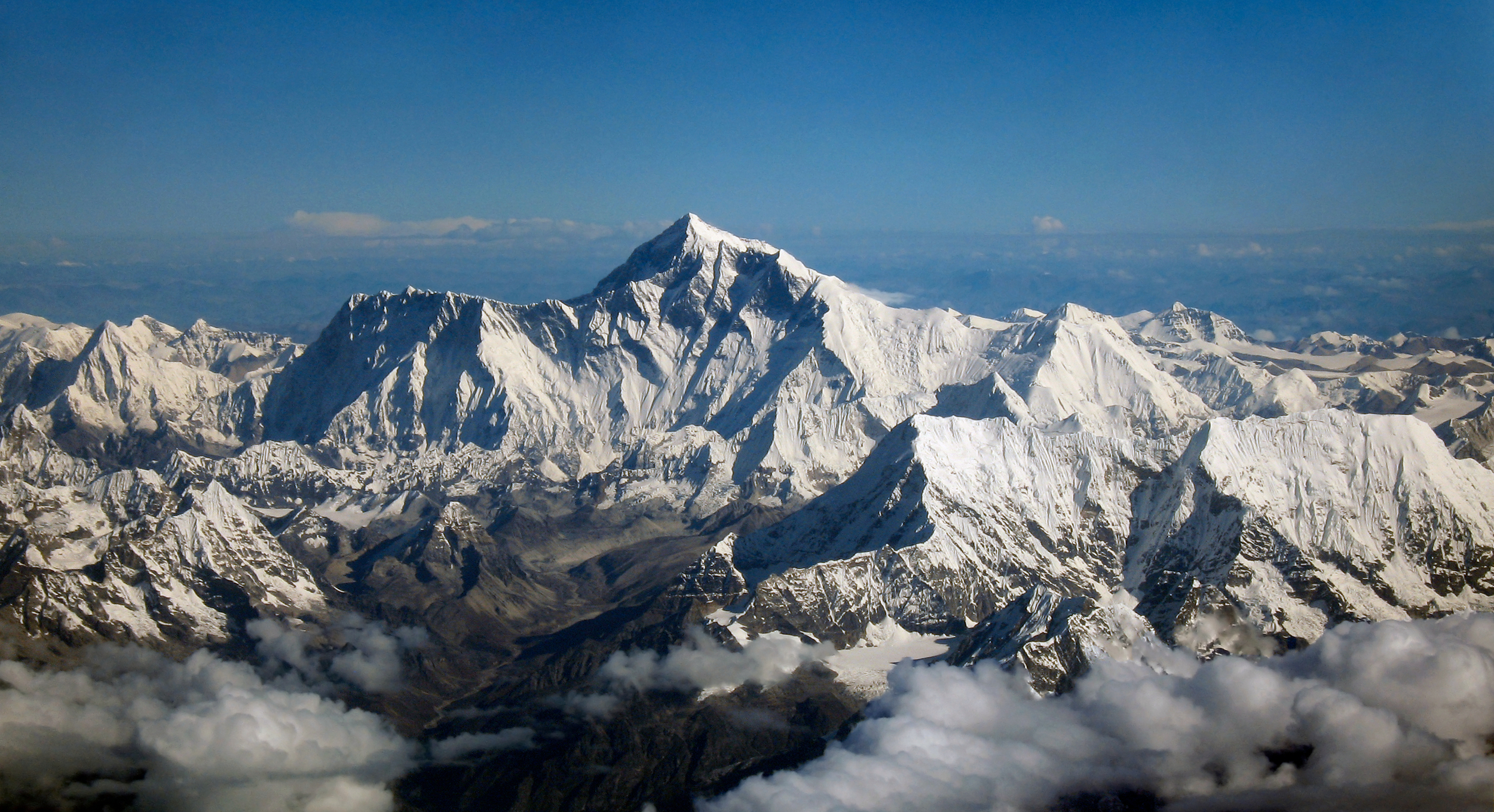
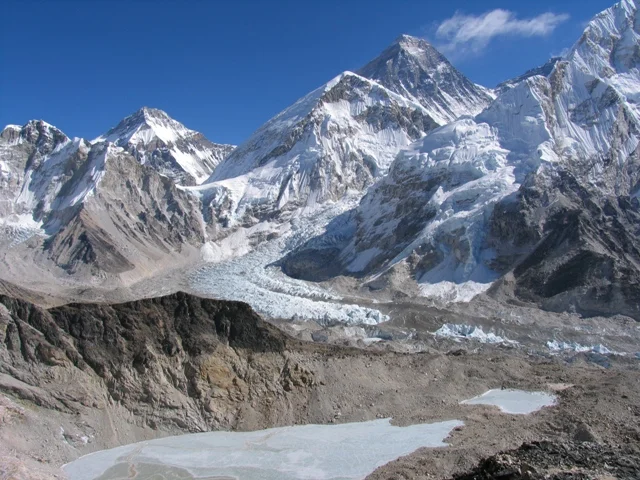
This trek is specially designed to reach the Everest Base Camp including Kala Pattar which is the best view point to view the sunrise over the high Himalayas including the Mt. Everest. This trek requires 13 days.
USD 1515 PER PERSON -- TWIN ROOM SHARING BASIS