
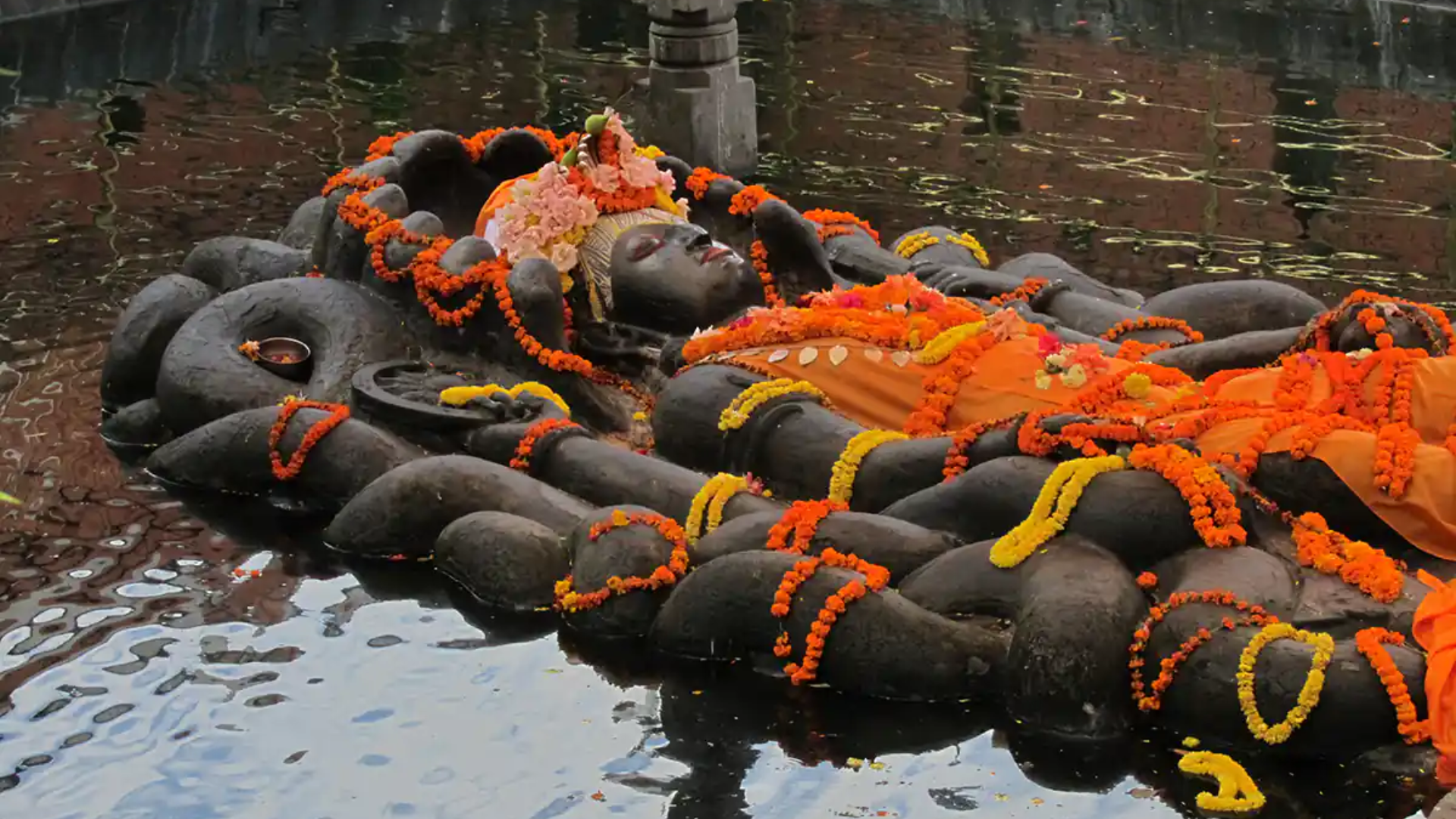
At the northern edge of Kathmandu Valley, beneath Shivapuri Hill, lies one of Nepal’s most quietly astonishing sacred sites. In a sunken stone pond rests a massive black stone figure of Lord Vishnu, reclining on the coils of the cosmic serpent Ananta. He appears asleep. He is not.
This is Budhanilkantha, often called the Sleeping Vishnu.
The statue is about five meters long, carved from a single block of basalt stone. Vishnu lies in yogic sleep, known as yoga nidra, floating upon the serpent whose many hoods rise protectively above him. In Hindu cosmology, this is not ordinary sleep. It is the pause between cycles of creation. When Vishnu dreams, universes emerge. When he awakens, worlds dissolve and begin again.
The image is dense with symbolism. Vishnu represents preservation and cosmic order. Ananta, the endless serpent, symbolizes infinity and time without beginning or end. The water surrounding the statue evokes the primordial ocean from which creation arises. This is theology rendered in stone.
Local tradition holds that the statue was discovered centuries ago by a farmer plowing his field. His plow struck something hard. When the soil was cleared, the divine form emerged. The land itself, the story suggests, revealed the god.
Now we arrive at the strange and persistent legend that shaped Nepal’s royal history.
For generations, it was believed that Nepal’s monarchs could not visit Budhanilkantha. The reason traces back to a prophecy. According to the myth, a Malla king once had a dream in which Vishnu warned that if a reigning king of Nepal were to look upon the deity at Budhanilkantha, death would soon follow.
Dreams in South Asian royal traditions were not treated as psychological trivia. They were messages, omens, instructions. Kings governed not only through politics but through alignment with divine will. Ignoring such a warning would have been reckless.
The belief solidified over time. Shah dynasty monarchs reportedly avoided the temple entirely. Even King Mahendra and King Birendra, in the modern era, are said to have respected the tradition. Whether from faith, caution, or cultural continuity, the taboo endured.
Was it superstition? A political safeguard? A myth retroactively strengthened by coincidence? We enter working-theory territory here. Human societies often encode cautionary principles into sacred stories. A prophecy can function as a stabilizer. It keeps power humble. It reminds rulers that sovereignty has limits.
There is also symbolic irony at play. In Nepal’s historical imagination, the king was regarded as an incarnation of Vishnu. How can one incarnation stand before another? The taboo may reflect theological tension. Two embodiments of divine authority cannot casually confront each other without unsettling cosmic hierarchy.
Whatever its origin, the belief endured for centuries. The statue remained accessible to ordinary devotees while remaining off-limits to the nation’s highest earthly authority. There is something quietly democratic in that.
Standing before the Sleeping Vishnu today, the atmosphere feels calm, almost meditative. Devotees circle the pond, offer flowers, ring bells softly. The god rests, serene, detached from human urgency.
Empires rise. Monarchies fall. Nepal’s royal era ended in 2008. The prophecy no longer binds a king. Yet the story remains, folded into collective memory.
Budhanilkantha endures as a reminder that power is always provisional. Even kings once stepped back from the edge of that sacred pool. And in the still water, beneath the coiled serpent of infinity, Vishnu continues to dream the world into being.
POPULAR ITINERARIES


SIMILAR POSTS


This trek is specially designed to reach the Everest Base Camp including Kala Pattar which is the best view point to view the sunrise over the high Himalayas including the Mt. Everest. This trek requires 13 days.
USD 1515 PER PERSON -- TWIN ROOM SHARING BASIS